1918 US 24-Cent Jenny Airmail Position 58
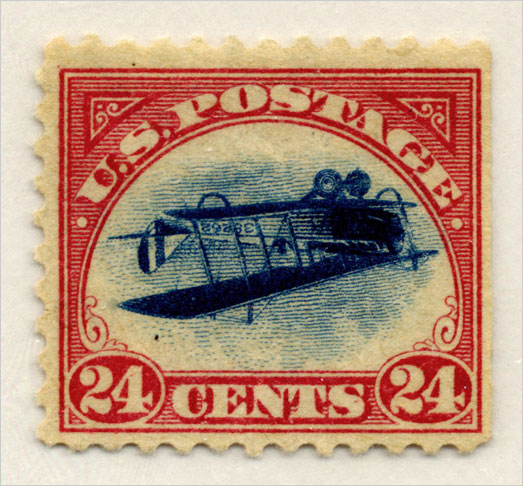
U.S. Postal Service via Wikimedia Commons (Public Domain)
The Inverted Jenny is the most celebrated error stamp in American philately, and Position 58 is one of its 100 individual stamps, each carrying a unique story, provenance chain, and market biography. If you have ever wanted to understand why a single 24-cent postage stamp can command over a million dollars at auction, Position 58 is the perfect lens through which to explore that question.
The Birth of an Accidental Masterpiece
On May 10, 1918, the Bureau of Engraving and Printing rushed to produce a new 24-cent airmail stamp for the United States Post Office. The occasion was historic: the country was about to launch its first scheduled airmail service, connecting Washington D.C., Philadelphia, and New York City. The stamp depicted a Curtiss JN-4 biplane (the "Jenny") in a patriotic red-and-blue design.
Because the stamp used two colors, each sheet of 100 stamps had to pass through the flat-bed printing press twice: once for the red frame and once for the blue center (the airplane). At least three misprinted sheets were caught and destroyed during production. One was not.
Exactly how the surviving error sheet slipped through remains a matter of debate. Either a worker fed a sheet into the press upside-down for the second color run, or the printing plate was mounted inverted. Either way, the result was 100 stamps with the Curtiss Jenny flying upside-down inside its red frame.
The entire batch of 100 was sold to William T. Robey at a Washington D.C. post office on May 14, 1918, the day before the first airmail flight. Robey had specifically gone stamp-hunting for potential errors, and when the clerk slid the sheet across the counter, Robey described his heart "standing still." He paid $24 for the sheet and quickly sold it to dealer Eugene Klein for $15,000. Klein then sold it to Colonel Edward Green for $20,000.
Green eventually had the sheet broken up. The 100 stamps were separated and dispersed into the philatelic marketplace, where each has traveled through auctions, private sales, and collections ever since.
Understanding Plate Positions
When Green's estate dispersed the sheet, philatelists began meticulously documenting each stamp by its position in the original 100-stamp pane. Positions run left-to-right, top-to-bottom, from 1 through 100. Position 58 falls in row 6, column 8 of that original sheet.
Each position carries its own set of characteristics: precise centering relative to the perforations, gum status, any faults or natural occurrences (like gum bends or blind perfs), and the provenance chain from Robey's purchase to the present day. The dedicated research site invertedjenny.com maintains the most current known history for each of the 100 positions.
Position 58 carries the distinction of being graded 95 by Professional Stamp Experts (PSE) and last recorded as sold in 2016, indicating it is a high-quality sound example with original gum. A PSE grade of 95 places it in the "Superb" category, reflecting exceptional centering and fresh original gum.
Condition Grades and What They Mean
Understanding grading is essential for evaluating any Inverted Jenny. The major grading services (PSE and Philatelic Foundation) use a numeric scale where:
| Grade | Category | Description |
|---|---|---|
| 98 | Superb | Near-perfect centering, full OG, no faults |
| 95 | Superb | Exceptional centering, OG, sound |
| 90 | Extremely Fine | Very well centered, OG |
| 85 | Extremely Fine | Above average, slight imbalance |
| 80 | Very Fine | Noticeably but acceptably off-center |
| 75 | Fine-Very Fine | Moderate centering issues |
| 70 | Fine | Stamps clearly off-center on one or more sides |
| Below 70 | Lower grades | Faults, heavy hinging, thins |
A grade of 95 is genuinely exceptional for a 1918 stamp that has spent over a century in collector hands. At the highest grades, the premium commanded over average examples is enormous.
Gum status abbreviations matter too: NH (never hinged) commands the greatest premium; OGph (original gum, previously hinged) is common for older stamps; NG (no gum) or regummed examples carry significant discounts.
Auction History and Market Values
The Inverted Jenny market has been remarkably active and well-documented:
| Year | Sale | Price |
|---|---|---|
| 2007 | Single Siegel auction (Nov) | $977,500 |
| 2007 | Single, mint NH, private sale (Dec) | $825,000 |
| 2005 | Block of four, Siegel | $2,700,000 |
| 2016 | Single, graded XF-Superb 95, Siegel | $1,351,250 (with buyer's premium) |
| 2018 | Position 49 (newly discovered), Siegel | $1,593,000 |
| 2023 | Single, Siegel (record hammer) | $2,006,000 (with buyer's premium) |
| 2025 | Recent auction result | ~$2,970,000 (with buyer's premium, per some reports) |
Position 58, with its grade of 95, sits firmly in the top tier of the market. The Scott Catalog has historically assigned individual Inverted Jennys catalog values in the range of $450,000 to over $600,000, with realized auction prices for choice examples substantially exceeding catalog values.
For context, the face value of $0.24 in 1918 was equivalent to roughly $5.14 in modern purchasing power. The return on investment for William Robey's $24 sheet purchase would be difficult to beat in any other asset class.
What Makes Position 58 Particularly Noteworthy
Several factors elevate Position 58 above the median Inverted Jenny:
The grade: A certified 95 places it among the finest-quality survivors. The original 100-stamp sheet was handled, separated, and distributed over a century ago. Finding a stamp in this condition after all that time is genuinely rare.
Sound status: The position record indicates it is "sound," meaning no tears, thins, creases, or significant faults. Many Inverted Jennys do carry faults, which significantly reduce value.
Complete documentation: The invertedjenny.com database maintains provenance records for every known position. Documented provenance is critical in the high-end philatelic market, both for authentication and for the narrative that sophisticated buyers prize.
The 2016 sale: The fact that Position 58 sold as recently as 2016 means there is a relatively recent price reference point, and that it likely carries modern expertization certificates.
Authentication and Expertization
Never buy an Inverted Jenny without a current certificate from either the Philatelic Foundation (PF) or Professional Stamp Experts (PSE). Forgeries exist, and the enormous value of genuine examples makes them frequent targets for fakers. A certificate from a recognized expertizing service is not optional at this price level.
When examining certificates, verify:
The certificate date (prefer certificates from 1990 or later, with current service preferred)
That the certificate number matches the stamp's hinge mark or backing
The grade and any noted faults
Gum status (NH, OGph, OGph-NH, NG)
The Philatelic Foundation has examined virtually all known Inverted Jennys, and their expert opinions form the authoritative record for many positions.
How the 100 Stamps Have Fared
Of the original 100 stamps, nearly all are accounted for in the invertedjenny.com database. A small number have not been publicly seen in decades and their current whereabouts are unknown. The majority appear in museum collections or in the hands of major collectors.
The Smithsonian's National Postal Museum holds multiple examples, including the plate position 70 stamp. The National Philatelic Collection is perhaps the most prestigious institutional home for any stamp.
Several positions are known to exist in pairs or blocks (sections of the original sheet that were never separated). Blocks and pairs command substantial premiums over individual singles because they represent intact sections of the historic original sheet.
Buying and Selling an Inverted Jenny
If you are ever in the position of buying or selling an Inverted Jenny, the process is highly specialized:
Major auction houses: Robert A. Siegel Auction Galleries in New York is the dominant venue for high-end U.S. philatelic material and has handled more Inverted Jenny sales than any other house. Kelleher Auctions, H.R. Harmer, and Cherrystone Auctions also handle major material.
Private treaty: Many high-value stamps trade privately, sometimes through dealers like Siegel's private treaty division. This can be advantageous for sellers seeking confidentiality or speed.
Condition is everything: The difference between a fine-grade (70) and superb (95) example can be hundreds of thousands of dollars. Never assume your stamp's condition. Get it graded.
Buyer's premiums: Major auction houses charge 15-20% buyer's premiums on top of the hammer price. Factor this into your calculations.
The Curtiss JN-4 Connection
The stamp's subject, the Curtiss JN-4, was itself a historic aircraft. The "Jenny" was the primary training aircraft for American pilots during World War I and was the workhorse of early American aviation. The specific airplane engraved on the stamp, Jenny #38262, was one of only six JN-4HM models modified for mail service (the second pilot's seat was removed to make room for mail bags, and fuel capacity was increased).
In one of those pleasing historical coincidences, Jenny #38262 was indeed chosen to fly the inaugural airmail run from Washington on May 15, 1918. The pilot, Lieutenant George Leroy Boyle, promptly got lost and made a crash landing in a field in Maryland. The plane depicted on the stamp was responsible for the chaotic first day of American airmail service.
The Inverted Jenny's Cultural Legacy
Few objects in American collecting history have captured the imagination the way the Inverted Jenny has. It has been the subject of museum exhibitions, documentaries, and academic papers. The USPS even issued a commemorative reprint of the Inverted Jenny in 2013, producing stamps in which the invert error was deliberately reproduced (with some sheets containing correctly-oriented planes to create a new generation of accidental rarities).
The 2013 reprint raised interesting questions about the nature of philatelic rarity, the role of intentional errors, and the definition of genuinely rare material. Original 1918 examples were entirely unaffected in value.
Explore More
Related Items
Have This Item?
Our AI appraisal tool is coming soon. Upload photos, get instant identification and valuation.
Get Appraisal