Penny Black Value & Price Guide (2026)
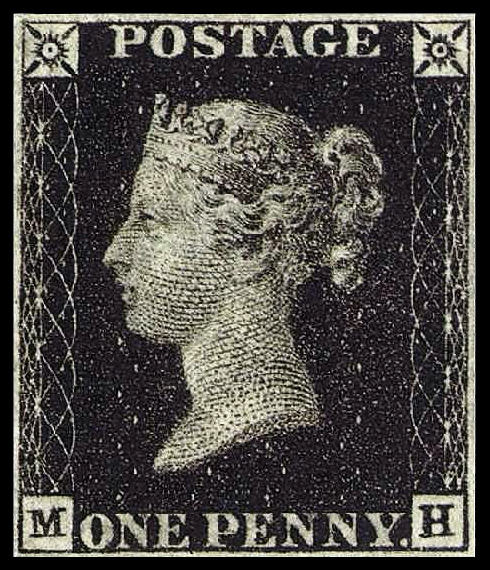
General Post Office of the UK, Public domain, via Wikimedia Commons
Before May 1, 1840, sending a letter was a mess. The recipient - not the sender - paid the postage. Rates varied by distance. Mail carriers had to collect money at every door. Then a British schoolteacher named Rowland Hill had a radical idea: let the sender pay a flat rate, proven by a small adhesive label stuck to the envelope. The result was the Penny Black - the world's first postage stamp. It changed how humans communicate, and you can still buy one today for less than you'd think.
Quick Value Summary
| Item | Penny Black (SG #1) |
| Year | 1840 |
| Category | Stamps - Great Britain |
| Denomination | One penny |
| Total Printed | ~68,158,080 (from 11 printing plates) |
| Condition Range | |
| Used, heavy cancel, faults | $75 – $300 |
| Used, good condition | $300 – $800 |
| Used, fine margins + light cancel | $800 – $2,000 |
| Unused, no gum | $2,000 – $5,000 |
| Unused, original gum | $5,000 – $15,000 |
| Plate 11 (rarest plate) | $15,000 – $50,000+ |
| Mint block of four | $50,000+ |
| Record Sale | £50,000+ (~$65,000) for a pristine four-block |
| Rarity | Common (used) / Rare (unused, Plate 11) |
The Story
By the 1830s, Britain's postal system was broken. Postage was calculated by distance and number of sheets. A letter from London to Edinburgh could cost a shilling - a day's wages for a laborer. Recipients often refused delivery rather than pay. Up to half of all mail went undelivered.
Rowland Hill published a pamphlet in 1837 proposing a revolutionary fix: a uniform penny rate for any letter under half an ounce, paid in advance by the sender using a prepaid label. Parliament approved the plan. On May 6, 1840, the Penny Black went into circulation.
The stamp features a profile of a young Queen Victoria, engraved from a medal by William Wyon. It's printed in black ink on white paper, with "POSTAGE" across the top and "ONE PENNY" at the bottom. Small letters in the lower corners identify each stamp's position on the 240-stamp printing sheet.
The public loved it. In the first year, over 72 million letters were sent - more than double the previous year's volume. But the Post Office quickly discovered a problem: black cancellation marks were nearly invisible on the black stamp. People were washing off the cancellations and reusing stamps. Within a year, the Penny Black was replaced by the Penny Red, which showed cancellation marks more clearly.
The Penny Black was in use for less than a year. But in that brief window, it invented modern postage.
How to Identify It
Key Visual Markers
Color: Black (ranging from deep black to grayish-black depending on plate and ink batch)
Design: Profile of young Queen Victoria facing left
Text: "POSTAGE" at top, "ONE PENNY" at bottom
Corner letters: Two letters in the bottom corners (A-T for row, A-L for column)
No perforations - the Penny Black is imperforate. Stamps were cut from sheets with scissors.
Maltese Cross cancellation - most used copies bear a red or black Maltese Cross cancel
Margins Matter
Because stamps were cut by hand, margin size varies enormously. A stamp with four wide, even margins is worth significantly more than one that's been cut close or into the design. Look at all four sides.
Plate Numbers
The Penny Black was printed from 11 different plates. Most plates produced millions of stamps, but Plate 11 produced only about 168,000 before being retired early. Plate 11 stamps are by far the rarest and most valuable - worth $15,000 to $50,000+ even in used condition.
Identifying the plate requires examining the corner letters and comparing them to reference guides. A specialist or auction house can help with this.
Don't Confuse It With...
Penny Red - Same design but printed in red/brown. Far more common. Worth $1 to $50 in most conditions.
Two Pence Blue - Issued the same day, same design, but in blue and valued at two pence. Scarcer than the Penny Black.
Modern reproductions - Commemorative reprints exist. They won't have the correct paper, ink, or printing characteristics.
Value by Condition
Used with Heavy Cancellation
The most common find. The Maltese Cross cancel is heavy, margins may be tight or cut into, and the stamp may have creases, thins, or stains. $75 to $300. Still a genuine piece of postal history from 1840 - and a great entry point for collectors.
Used, Good Condition
Clear design, four margins (even if close), identifiable cancel that doesn't obscure the portrait. $300 to $800. This is where most "nice" Penny Blacks fall.
Used, Fine Margins + Light Cancel
Four clear margins, a light or attractive Maltese Cross cancel (especially in red), no faults. $800 to $2,000. Red Maltese Cross cancels from the earliest months of use (May–June 1840) command a premium.
Unused, No Gum
An unused Penny Black without its original gum. Scarce - most were used. $2,000 to $5,000.
Unused, Original Gum
Extremely scarce. An 1840 stamp that was never used and still has its original adhesive. $5,000 to $15,000 depending on gum quality and margins.
Plate 11
Any Plate 11 Penny Black commands a significant premium regardless of condition. Used copies start around $15,000. Fine examples can reach $50,000 or more.
Authentication & Fakes
How Common Are Fakes?
The Penny Black itself isn't frequently faked - there are millions of genuine used copies, so the economics don't favor counterfeiting low-grade examples. However, Plate 11 copies are sometimes fabricated or misidentified, and unused copies with "original gum" may have been re-gummed.
What to Watch For
Re-gumming: Adding new gum to make a used stamp appear unused. Detectable under UV light or by an expert examining the gum's consistency.
Plate 11 misidentification: Accurate plate identification requires expertise. Don't trust a seller's plate attribution without verification.
Repaired margins: Stamps with margins added or extended to improve appearance. Visible under magnification.
Penny Red dyed black: Rare but it happens. Paper fiber analysis will catch this.
When to Get Authentication
For any Penny Black you're considering buying for over $500, or if you believe you have an unused copy or Plate 11 variety, seek authentication from the Royal Philatelic Society London or a recognized expert. For standard used copies under $300, authentication usually isn't necessary.
Where to Sell
Common Used Copies (under $500)
eBay - Strong market for Penny Blacks, especially with good photos
Stamp dealers - Quick sale at wholesale price
Stamp shows - Compare offers from multiple dealers
Better Examples ($500+)
Stanley Gibbons - The world's leading philatelic dealer, London-based
Warwick & Warwick - UK auction house specializing in stamps
Spink - Major auction house with strong philatelic department
Heritage Auctions - For U.S.-based sellers
Rare Varieties (Plate 11, Unused, Blocks)
Sotheby's or Christie's - For top-tier material
Spink or Stanley Gibbons - Specialist reach
Not sure what your old stamps are worth? Upload a photo to Curio Comp for a free AI estimate. Upload a photo →
Common Questions
How much is a Penny Black worth?
Most used Penny Blacks sell for $75 to $800 depending on condition, margins, and cancellation quality. Unused copies range from $2,000 to $15,000. The rare Plate 11 variety starts at $15,000 and can exceed $50,000.
Are Penny Blacks rare?
Not really - about 68 million were printed, and millions survive. But "common" for a stamp from 1840 is still remarkable. Unused copies and Plate 11 varieties are genuinely rare. The Penny Black's value comes more from its historical significance than its scarcity.
How can I tell what plate my Penny Black is from?
The plate is identified by examining the corner letters and comparing them to cataloged reference sheets. Plates 1a, 1b, and 2 through 11 each have slight differences. Plate 11 is the one you're hoping for - only 168,000 were printed. A philatelic specialist can help with identification.
Is a Penny Black a good investment?
Penny Blacks have held or increased in value steadily over decades. They're among the most recognizable stamps in the world, with consistent collector demand. A fine used copy is one of the most affordable ways to own a genuinely historic collectible - and that appeal doesn't fade.
What's the difference between a Penny Black and a Penny Red?
Same design, different color. The Penny Black (1840) came first but was replaced by the Penny Red (1841–1879) because black cancellation marks didn't show up on black stamps. Penny Reds are far more common and worth much less - typically $1 to $50.
Related Items
Have This Item?
Our AI appraisal tool is coming soon. Upload photos, get instant identification and valuation.
Get Appraisal