1953 Danelectro U-1 (Masonite Body, Lipstick Pickup)
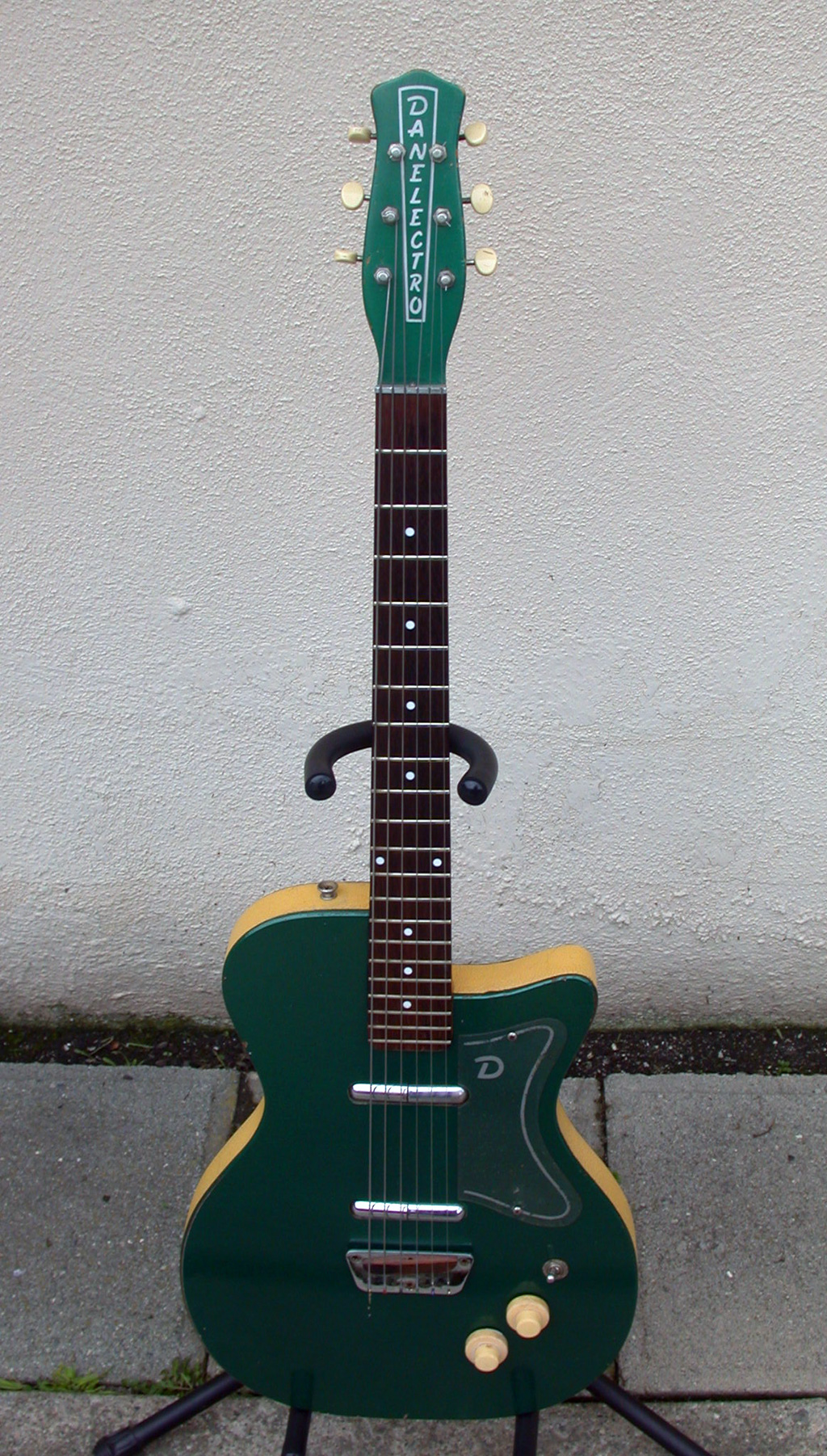
Original 1956 Jade Green Danelectro U2 (same body/pickup design as the U-1). Photo by Jazzypants123, 2009. Licensed under Creative Commons (multiple licenses available). Via Wikimedia Commons.
There is something wonderfully paradoxical about the Danelectro U-1. It was built cheap, designed fast, sold to mail-order customers who wanted a guitar without breaking the bank, and constructed from materials more commonly found in cabinets and bathroom fixtures than in a music store. And yet, seven decades later, original 1953 U-1s are coveted by serious collectors, prized by recording engineers for their distinctive tone, and studied by lutherie scholars as a genuine innovation in electric guitar design. The U-1 is one of those rare objects where economy of means produced something genuinely special.
Nathan Daniel and the Origins of Danelectro
Before there was a Danelectro guitar, there was Nathan Daniel. A Brooklyn-born electronics engineer, Daniel had been building amplifiers for Epiphone in the 1930s before Epiphone's management pushed for an exclusivity arrangement he refused. He went independent, eventually landing contracts to supply amplifiers to Montgomery Ward and then, by 1948, becoming the exclusive guitar amplifier producer for Sears Roebuck.
The Sears relationship would define Danelectro for a decade. Sears wanted affordable instruments for the mass market, sold through catalogs under the Silvertone house brand. Daniel obliged, and to deliver playable instruments at catalog prices, he had to engineer his way around the cost constraints that would have stopped a conventional guitar maker.
The solution was radical: instead of carved or routed wood bodies, Daniel built guitars from Masonite, a pressed hardboard most commonly used in construction and cabinetry. He framed the guitars with a poplar wood outline, then stapled Masonite sheets to the front and back. The sides were covered in vinyl (maroon for Silvertone, off-white tweed for Danelectro-branded instruments). The neck, rather than using a conventional truss rod, relied on a 3/4-inch square aluminum tube running from headstock to body for rigidity.
The result was a guitar that could be built quickly, cheaply, and consistently. The tone was something nobody expected.
The Lipstick Tube Pickup
Nothing about Danelectro's construction is more famous than the "lipstick tube" pickup. Daniel needed an inexpensive single-coil pickup that could be produced in quantity. The solution was to wind a simple coil around an alnico bar magnet and house the entire assembly inside a metal cylinder, specifically a surplus tube from a lipstick manufacturer. The resulting pickup had low output, a glassy high-end response, and a compressed, nasal mid-range quality that was immediately distinctive.
On its own, the lipstick pickup sounds thin. Mixed into a recording session, especially through a slightly driven amplifier, it cuts through a mix with a clarity that many more expensive pickups cannot match. The Beatles used Danelectros. Led Zeppelin used them. Jimi Hendrix occasionally reached for one. Jimmy Page used a Danelectro on the studio version of "Kashmir." The reason was always the same: that pickup does something unique.
What Makes the 1953 U-1 Special
The U-1 designation denoted "one pickup," distinguishing it from the U-2 two-pickup model. By 1953, Nathan Daniel had developed the design but the first guitars only began shipping in late 1954. Instruments correctly dated or attributed to the 1953 production prototype period represent pre-production or very early manufacturing, making them extremely rare.
The earliest Danelectros from 1954 and 1955 share the same essential DNA as the 1953 prototypes:
Body construction: Masonite top and back on a poplar frame
Neck: Bolt-on poplar with 3/4-inch aluminum reinforcement tube
Pickup: Single lipstick-tube single-coil
Controls: Two white Bakelite knobs (volume, tone)
Headstock: Three-and-three tuner arrangement with distinctive asymmetric shape
Bridge: Adjustable rosewood bridge on a metal tailpiece
The earliest models had the pickguard concealing the pickup controls in a distinctive way, with the single pickup sitting beneath a baked melamine pickguard. Scale length was 25 inches, which gives these early Danelectros a slightly different feel from the later shortscale variants.
Specifications
| Specification | Detail |
|---|---|
| Model | U-1 (one pickup) |
| Production Start | Late 1954 (1953 design finalized) |
| Body | Masonite top/back, poplar frame |
| Body Covering | Off-white tweed (Danelectro) / Maroon vinyl (Silvertone) |
| Neck | Poplar, bolt-on, aluminum reinforcement |
| Scale Length | 25 inches |
| Pickup | Single lipstick-tube single-coil |
| Controls | Volume and tone (white Bakelite knobs) |
| Tuners | 3-per-side arrangement |
| Bridge | Rosewood saddle, adjustable metal tailpiece |
| Country | USA (Red Bank, NJ) |
Condition Grades and Collector Values
Original 1950s Danelectros occupy a fascinating market position. They are not as expensive as vintage Fenders or Gibsons, but genuine early examples in excellent condition have climbed steadily in price as the collector community for "off-brand" vintage instruments has matured.
| Condition | Description | Approximate Value |
|---|---|---|
| Player | Functional but worn, refins, replacements common | $300 - $500 |
| Good | All original parts, honest wear, plays well | $600 - $900 |
| Very Good | Original finish 80%+, all original hardware, good neck | $900 - $1,500 |
| Excellent | 90%+ finish, all original, clean electronics | $1,500 - $2,500 |
| Near Mint | Near-factory condition, original case | $2,500 - $4,000+ |
True 1953-dated or credibly early-1954 examples with documentation can command premiums above these ranges, particularly when sold to specialists.
What Collectors Look For
Originality is everything. Danelectros are easy to work on and have been endlessly modified over the decades. An all-original example with its original lipstick pickup, original Bakelite knobs, original tuners, and even the original strap buttons carries a significant premium over a parts-swapped player. The neck condition is critical: the aluminum reinforcement tube prevents warping, but checking the alignment and fret condition is standard.
The Masonite trap. Original Danelectro bodies can delaminate where the Masonite pulls away from the poplar frame, especially at the corners and around the pickup rout. Surface bubbling or separation is the most common structural fault. Light separation that has been cleanly reglued is acceptable to most collectors. Extensive delamination or water damage is serious.
Pickguard integrity. The baked melamine pickguard on early U-1s is brittle and chips easily. All-original pickguards without chips or cracks add value. Replacements are common and detract.
The knobs. Original white Bakelite volume and tone knobs are period-correct. Yellow or aged-white plastic replacements from the 1970s are the most common substitution.
The Sound in Context
Record producers have chased the Danelectro tone for decades for reasons that go beyond nostalgia. The lipstick pickup's low output means it responds dynamically to playing intensity. Pick hard, and the signal stays clean but present. Dig in through a tube amp on the edge of breakup, and the compression is smooth and musical rather than harsh.
The relatively bright, nasal character of the bridge pickup cuts through horn sections and organ beds in a way that a warmer humbucker cannot. The neck pickup on a U-2 (two-pickup variant) produces a peculiar, cello-like tone when both pickups are selected in series (Danelectro wired them in series, not parallel, creating that distinctive "both pickups" sound that is unlike anything else in the guitar world).
For the U-1, there is only the bridge pickup, but it is all anyone needs for the core Danelectro tone.
Why This Instrument Matters
The Danelectro U-1 arrived at a moment when the electric guitar was becoming democratized. Before instruments like this, a player of modest means could not afford the tools that professional musicians used. The U-1 changed that equation, and in doing so, it put electric guitars in the hands of a generation of players who would define popular music for the next fifty years.
The irony is that the constraints that made it cheap also made it interesting. If Nathan Daniel had been able to afford proper tonewoods and standard pickups, the Danelectro sound would never have existed. The lipstick tube, born of salvage and economy, turned out to be a genuinely great pickup. The Masonite body, born of necessity, produces a resonance that modern builders have spent years trying to replicate.
Collecting these early Danelectros is collecting the accidental history of rock and roll.
Related Items
Have This Item?
Our AI appraisal tool is coming soon. Upload photos, get instant identification and valuation.
Get Appraisal