Gibson SG Standard (1961-1963 with Sideways Vibrola)
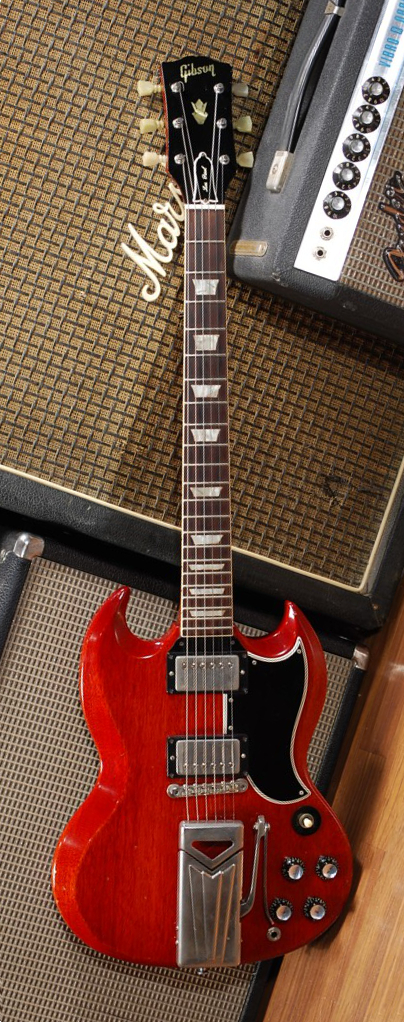
Clusternote/Sellenman, CC BY-SA 3.0, via Wikimedia Commons
A Guitar With an Identity Crisis
In 1961, Gibson redesigned the Les Paul Standard from the ground up. Gone was the heavy, carved-top mahogany and maple body that defined the 1950s Les Paul. In its place: a thin, double-cutaway mahogany slab with pointed horns, beveled edges, and a cherry red finish. It was lighter, faster, and easier to play in the upper registers.
There was just one problem. Les Paul himself hated it.
The guitarist had no input on the redesign. His marriage to Mary Ford was falling apart, and his TV show had been cancelled. Sales of the original Les Paul had slumped. Gibson moved forward without him. The new guitar still carried his name on the headstock and his signature on the pickguard, but Les Paul wanted nothing to do with it.
By late 1963, Gibson and Les Paul officially parted ways. The guitar was renamed the SG Standard (SG for "Solid Guitar"). But those early examples, built between 1961 and 1963 with the Les Paul name and the distinctive sideways vibrola tailpiece, occupy a unique space in guitar collecting. They are not quite Les Pauls. They are not quite SGs. They are both.
And they are worth serious money.
Quick Value Summary
| Condition | Approximate Value (2024-2025) |
|---|---|
| Poor (heavy modifications, repairs) | $8,000 - $12,000 |
| Fair (some replaced parts, wear) | $12,000 - $18,000 |
| Good (all original, player wear) | $18,000 - $25,000 |
| Excellent (clean, minimal wear) | $25,000 - $35,000 |
| Near Mint (exceptional condition) | $35,000 - $50,000+ |
Prices based on Reverb, Heritage Auctions, and dealer listings from 2023-2025. Sideways vibrola models (1961-early 1962) command the highest premiums. Guitars with the later ebony block vibrola (mid 1962-1963) typically sell for 10-20% less.
The Story
The Birth of the SG Shape
By 1960, Gibson's Les Paul line was struggling. Annual sales of the Les Paul Standard had dropped to around 600 units. The single-cutaway design felt dated compared to Fender's sleek Stratocaster and Jazzmaster. Gibson president Ted McCarty tasked his team with a complete redesign.
The result was radical. The new body was thinner (about 1.5 inches compared to the Les Paul's 2+ inches), lighter (typically 6 to 7 pounds versus 8 to 10), and featured two sharp cutaways that gave players access to all 22 frets. The neck joint was moved deeper into the body, meeting at the 22nd fret instead of the 16th.
Gibson kept the core electronics: two PAF (Patent Applied For) humbucking pickups, two volume controls, two tone controls, and a three-way toggle switch. The neck remained one-piece mahogany with a rosewood fingerboard and trapezoid inlays.
The new model launched in early 1961. It was officially called the "Les Paul Standard" in Gibson's catalogs, priced at $290 (about $3,000 in today's dollars).
The Sideways Vibrola
The most distinctive feature of the earliest SG Standards is the sideways vibrola tremolo system. This was a spring-loaded tailpiece that moved side to side (horizontally) rather than up and down like a Bigsby or Fender tremolo. Gibson called it the "side-to-side" or "sideways" vibrola.
The mechanism was novel but flawed. The side-to-side motion made subtle pitch bending awkward. Many players found it imprecise and frustrating. Some removed it entirely and installed a stop tailpiece. Others simply avoided using it.
By mid-1962, Gibson began transitioning to the ebony block vibrola, a short, blocky unit that moved in a more conventional up-and-down motion. By 1963, this was replaced again by the Maestro Lyre vibrola, which became the standard tremolo for SG models through the mid-1960s.
The sideways vibrola appeared on SG Standards for roughly 18 months. That short production window, combined with the fact that many were removed or replaced over the decades, makes an original sideways vibrola SG Standard a genuinely rare guitar.
The Split With Les Paul
Les Paul's endorsement deal with Gibson ran through the early 1960s. When it came up for renewal, Les Paul declined. He reportedly disliked the new design and did not want his name associated with it. Gibson dropped the Les Paul name from the model in late 1963.
This means the earliest SG Standards (1961-1963) say "Les Paul" on the headstock and have his signature on the pickguard. Post-1963 models say "SG Standard" only. For collectors, the Les Paul-marked examples carry additional historical significance and a price premium.
How to Identify
Key Features of a 1961-1963 SG Standard with Sideways Vibrola
The vibrola. The sideways vibrola is a chrome or nickel unit with a flat arm that extends to the player's right. It mounts to the top of the guitar with screws and has a spring mechanism that allows the tailpiece to slide left and right. If the guitar has a Maestro Lyre vibrola or a stop tailpiece, it is either a later model or has been modified.
Les Paul markings. The headstock should read "Les Paul" in a pearl inlay below the Gibson logo. The black pickguard should have a Les Paul signature silkscreened in gold or white.
PAF pickups. Original 1961-early 1962 examples have PAF (Patent Applied For) stickers on the pickup base plates. By mid-1962, Gibson transitioned to "Patent Number" pickups with an actual patent number stamped on them. Both are highly valued, but PAF pickups command a premium.
Nickel hardware. All hardware (pickup covers, vibrola, tuners, bridge) should be nickel-plated. Gibson switched to chrome plating around 1965.
Cherry red finish. The standard finish was cherry red nitrocellulose lacquer. These guitars fade beautifully over time, often developing an orange or amber hue, especially on the back where the player's body contacts the guitar.
Slim taper neck. The 1961-1963 neck profile is relatively thin, often described as a "slim taper" or "1960s" profile. Neck width at the nut is approximately 1.625 inches.
Serial Number Dating
Gibson serial numbers from this era are notoriously unreliable. Starting in 1961, Gibson used impressed (die-stamped) serial numbers on the back of the headstock. The numbers were typically 5 or 6 digits.
General ranges:
1961: approximately 30,000 - 42,000
1962: approximately 42,000 - 61,000
1963: approximately 61,000 - 100,000+
These ranges overlap significantly. A guitar's serial number should be used alongside physical features (pickup type, hardware, potentiometer date codes) to confirm the year. Pot date codes are often the most reliable way to narrow down the production date.
How to Spot Reissues
Gibson has produced several reissues of the early SG Standard:
Gibson SG '61 Reissue (various years): Modern production with similar aesthetics but different construction details. Check the serial number format (modern Gibsons use 8+ digit serials), the truss rod cover (reissues often differ), and the quality of the aging if it is a "VOS" (Vintage Original Spec) model.
Gibson Custom Shop reissues: Higher quality reproductions that can fool casual observers. Look for Custom Shop markings inside the control cavity, modern wiring, and CTS potentiometers with recent date codes.
Aged/reliced models: Gibson and third-party shops create artificially aged guitars. The wear patterns on genuine 60+ year-old guitars are random and organic. Artificial aging tends to be more uniform.
Value by Condition
Condition is everything with vintage guitars. Here is how the market breaks down:
All-Original Examples
Near Mint (9/10): $35,000 - $50,000+. These are extraordinarily rare. A 60+ year-old guitar in near-mint condition means it was barely played and carefully stored.
Excellent (8/10): $25,000 - $35,000. Light player wear, minor finish checking, original case. This is the sweet spot for most serious collectors.
Very Good (7/10): $18,000 - $25,000. Moderate player wear, some finish loss, possible minor repairs (refret, re-soldered connections). All original parts.
Good (6/10): $14,000 - $18,000. Heavy player wear, possible buckle rash, but structurally sound with original parts.
Modified Examples
Changed pickups: Deduct 15-30% depending on what was installed and whether originals are included.
Changed vibrola/tailpiece: A missing or replaced sideways vibrola significantly reduces value. If a stop tailpiece was installed (requiring new holes), deduct 25-40%.
Refinished: A professional refinish can reduce value by 40-60%.
Neck repair/reset: Common on SGs due to the shallow neck joint. A professional repair reduces value by 20-35%, but a clean repair on an otherwise original guitar is still worth far more than a heavily modified example.
Errors and Variations
Ebony block vibrola (mid 1962-1963): Some transitional examples use the short ebony block vibrola instead of the sideways unit. These are less sought-after than sideways vibrola models but still valuable ($12,000 - $28,000 depending on condition).
Stop tailpiece conversions: Many sideways vibrolas were removed by players in the 1960s and 1970s and replaced with stop tailpieces. If the original vibrola holes are still visible (or filled), this tells the guitar's story. Original conversion-era stop tailpieces can sometimes add interest for players.
Wide vs. narrow nut width: Early 1961 examples sometimes have a slightly wider nut (1.6875") compared to later production.
Pickup variations: PAF pickups have different magnet types and coil windings that affect tone. No two PAFs sound exactly alike, which is part of their appeal.
Authentication
Authentication of a 1961-1963 SG Standard requires hands-on inspection by a qualified expert. Key checkpoints:
Potentiometer date codes: The pots inside the control cavity have date codes stamped on them. The format is typically a three-digit code where the first digit indicates the manufacturer (137 = CTS) and the remaining digits indicate the week and year of production. Pots should date to 1961-1963.
Pickup inspection: Original PAF pickups have specific characteristics: black bobbins (usually), a "Patent Applied For" sticker, and specific wire types. Patent number pickups (post-1962) have a different sticker. Experts can identify reproduction stickers and incorrect components.
Wood and finish analysis: The mahogany body and neck should show appropriate aging. Nitrocellulose lacquer develops fine checking (tiny cracks) over decades. Polyurethane finishes (used on later guitars) do not check the same way.
Hardware inspection: Original nickel hardware develops a specific patina over time. Reproduction hardware is available and can look convincing, so close inspection of screw heads, spring tension, and wear patterns is important.
Recommended Experts
Gruhn Guitars (Nashville): George Gruhn is one of the world's foremost authorities on vintage Gibson guitars.
Heritage Auctions: Their musical instruments department authenticates consigned guitars.
Gibson Custom Shop (authentication service): Gibson offers official authentication letters for vintage instruments.
Where to Sell
Reverb.com: The largest online marketplace for musical instruments. Strong vintage guitar buyer base. Seller fees are approximately 5% + payment processing. Listings from $14,550 and up for sideways vibrola models have appeared on the platform.
Heritage Auctions: Best for high-value examples ($20,000+). Heritage has a dedicated musical instruments department with regular auctions. Buyer's premium is typically 25%, and seller commissions vary.
Gruhn Guitars / Elderly Instruments / Carter Vintage: Reputable vintage guitar dealers who buy outright or take consignments. Expect to receive 70-80% of retail value if selling directly to a dealer.
The Les Paul Forum / My Les Paul Forum: Online communities with classified sections where knowledgeable buyers shop. No fees, but you handle shipping and payment yourself.
Guitar shows: Events like the Arlington Guitar Show or the Philly Guitar Show attract serious vintage buyers. Good for face-to-face transactions.
Related Items
Have This Item?
Our AI appraisal tool is coming soon. Upload photos, get instant identification and valuation.
Get Appraisal