1913 Liberty Head Nickel Value & Price Guide (2026)
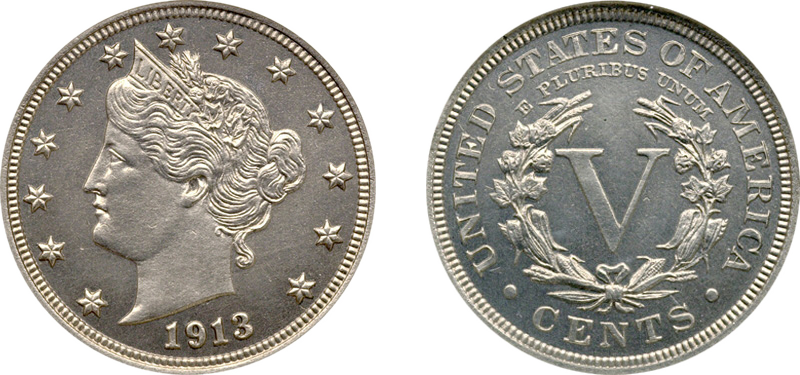
Public domain, via Wikimedia Commons
Five coins. That's all. The 1913 Liberty Head nickel was never supposed to exist - the design had been discontinued and replaced by the Buffalo nickel that same year. But someone at the Philadelphia Mint struck five of them anyway, in secret. Nobody knows exactly who or why. What we do know: one sold for $4,560,000 in 2018, and another brought $4,200,000 in 2022. It's the Holy Grail of American coins.
Quick Value Summary
| Item | 1913 Liberty Head Nickel |
| Year | 1913 |
| Category | Coins - U.S. Nickels |
| Composition | 75% copper, 25% nickel |
| Weight | 5.0 grams |
| Diameter | 21.2mm |
| Mint | Philadelphia (unauthorized) |
| Known Specimens | 5 |
| Value Range | $3,000,000 – $4,560,000+ |
| Record Sale | $4,560,000 (2018, Stack's Bowers) |
| Most Recent Major Sale | $4,200,000 (2022) |
| Rarity | Extremely Rare |
The Story
The Liberty Head nickel series ran from 1883 to 1912. In 1913, the U.S. Mint officially replaced it with James Earle Fraser's new Buffalo nickel design. No Liberty Head nickels were authorized for 1913. The old dies should have been destroyed.
But five 1913 Liberty Head nickels exist.
The mystery begins with Samuel W. Brown, a former Mint employee. In December 1919, Brown placed an advertisement in The Numismatist offering to buy 1913 Liberty Head nickels - a coin nobody had seen before. Within a year, Brown showed up at an American Numismatic Association convention with all five specimens. He had worked at the Philadelphia Mint in 1913.
The implication is clear. Someone inside the Mint - likely Brown himself, or a colleague - struck five Liberty Head nickels using the old 1913-dated dies before they were destroyed. It was unauthorized. It was probably illegal. And it created what became the most famous rarity in American numismatics.
Brown sold all five coins to Colonel E.H.R. Green, the wealthy son of Hetty Green (the "Witch of Wall Street"). After Green's death in 1936, the five nickels scattered across the collector world. Over the decades, they've passed through some of the most famous collections in numismatic history.
The Five Known Specimens
The Eliasberg Specimen - Proof-66. The finest known. Sold for $4,560,000 in 2018 at Stack's Bowers. Currently in a private collection.
The Olsen Specimen - Proof-64. Sold for $3,737,500 in 2014 at Heritage Auctions. Previously sold for $4,150,000 in 2010.
The Walton Specimen - VF/EF. The "lost" nickel. George Walton was killed in a car crash in 1962 while traveling to a coin show. His heirs submitted the coin to authentication, and it was declared a fake. It sat in a closet for 40 years until 2003, when it was re-examined and authenticated as genuine. Sold for $3,172,500 in 2013.
The Norweb Specimen - Proof-64. Donated to the Smithsonian Institution in 1978. Not for sale.
The McDermott/ANA Specimen - Proof-64. Owned by the American Numismatic Association. Displayed at the ANA Money Museum in Colorado Springs.
How to Identify It
Key Features
Obverse: Liberty in profile facing left, wearing a coronet inscribed "LIBERTY." Thirteen stars around the rim, date "1913" below.
Reverse: Large Roman numeral "V" (5) surrounded by a wreath of cotton and corn. "UNITED STATES OF AMERICA" and "E PLURIBUS UNUM" around the rim. "CENTS" below the V.
The Reality Check
Let's be direct: you don't have one. Only five exist, and all five are accounted for - two in museums, three in known private collections. The chance of finding a sixth 1913 Liberty Head nickel is essentially zero.
If you have what looks like a 1913 Liberty Head nickel, it's almost certainly:
An altered date. A common-year Liberty Head nickel (1883–1912) with the date changed to 1913.
A replica or novelty coin. Many reproductions have been made over the years.
A different coin entirely. The 1913 Buffalo/Indian Head nickel (Type 1 or Type 2) is extremely common and worth $1–$20.
If You're Still Convinced
Check the weight (5.0 grams) and composition. Look for "COPY" markings required by the Hobby Protection Act. Examine the date under magnification for signs of alteration. If it passes basic scrutiny, contact Heritage Auctions or Stack's Bowers - but expect it to be a reproduction.
Value History
The 1913 Liberty Head nickel has one of the most remarkable price histories in collecting:
| Year | Price | Notes |
|---|---|---|
| 1920 | ~$500 | Samuel Brown's asking price |
| 1972 | $100,000 | Major milestone |
| 1996 | $1,000,000 | First U.S. coin to reach $1 million |
| 2003 | $3,000,000 | Eliasberg specimen |
| 2010 | $3,737,500 | Olsen specimen |
| 2013 | $3,172,500 | Walton specimen (the "lost" nickel) |
| 2018 | $4,560,000 | Eliasberg specimen (current record) |
| 2022 | $4,200,000 | Walton specimen |
The value trend is consistently upward. Each time a 1913 Liberty Head nickel appears at auction, it's a numismatic event that attracts worldwide attention and aggressive bidding.
Authentication & Fakes
This Coin Is Never Found by Accident
Every known 1913 Liberty Head nickel is documented and tracked. The numismatic community knows where each one is. A "new" specimen would be the numismatic discovery of the century - and would require extraordinary proof of authenticity.
Common Fakes
Altered-date nickels. Someone takes a common Liberty Head nickel from 1903 or another year and alters the date to read 1913. Under magnification, the alterations are usually visible - tool marks, inconsistent digit style, or evidence of material removal and addition.
Henning counterfeits. In the 1960s, Francis Henning created counterfeits of Buffalo/Indian Head nickels dated 1939 through 1944. While these aren't Liberty Head nickels, they show that nickel counterfeiting has a long history.
Replica coins. Many obviously marked reproductions exist as educational or novelty items.
What to Do
If you believe you have a genuine 1913 Liberty Head nickel - after acknowledging how astronomically unlikely that is - contact Stack's Bowers or Heritage Auctions directly. Do not post it on eBay. Do not take it to a local coin shop. This is a coin that needs the top experts in the world.
Where to Sell
For a genuine 1913 Liberty Head nickel (which, again, would be the numismatic event of the decade):
Stack's Bowers - Has handled multiple specimens, including the $4,560,000 Eliasberg sale
Heritage Auctions - Sold the Olsen specimen for $3,737,500
Private treaty - At this level, some sales happen privately between ultra-wealthy collectors, often brokered by major dealers
There is no other appropriate venue. A $4+ million coin requires the most prestigious auction house in the world.
Not sure what you have? Upload a photo to Curio Comp for a free AI estimate. Upload a photo →
Common Questions
How much is a 1913 Liberty Head nickel worth?
Between $3,000,000 and $4,560,000 based on recent sales. The exact value depends on the specific specimen and its condition. The record is $4,560,000 for the Eliasberg specimen (Proof-66) in 2018.
How many 1913 Liberty Head nickels exist?
Exactly five. All are accounted for - two in museums (Smithsonian and ANA), three in private collections. No additional specimens have been discovered since 1920.
Why were 1913 Liberty Head nickels made?
They were unauthorized. Someone at the Philadelphia Mint - likely Samuel W. Brown, a Mint employee - secretly struck five coins using discontinued Liberty Head dies in 1913 before the new Buffalo nickel dies took over. It was never sanctioned by the Mint.
Could there be a sixth 1913 Liberty Head nickel?
It's theoretically possible but extremely unlikely. Only five have ever surfaced in over 100 years. If a sixth existed, it would need extraordinary provenance and authentication to be accepted by the numismatic community.
What's the story of the "lost" Walton nickel?
George Walton was killed in a car crash in 1962 while traveling to a coin show with his 1913 Liberty Head nickel. His heirs submitted it for authentication, and it was rejected as a fake. It sat in a closet for 40 years until 2003, when experts re-examined it and confirmed it was genuine. It sold for $3,172,500 in 2013 and again for $4,200,000 in 2022.
Related Items
Have This Item?
Our AI appraisal tool is coming soon. Upload photos, get instant identification and valuation.
Get Appraisal