1912-S Liberty Head Nickel
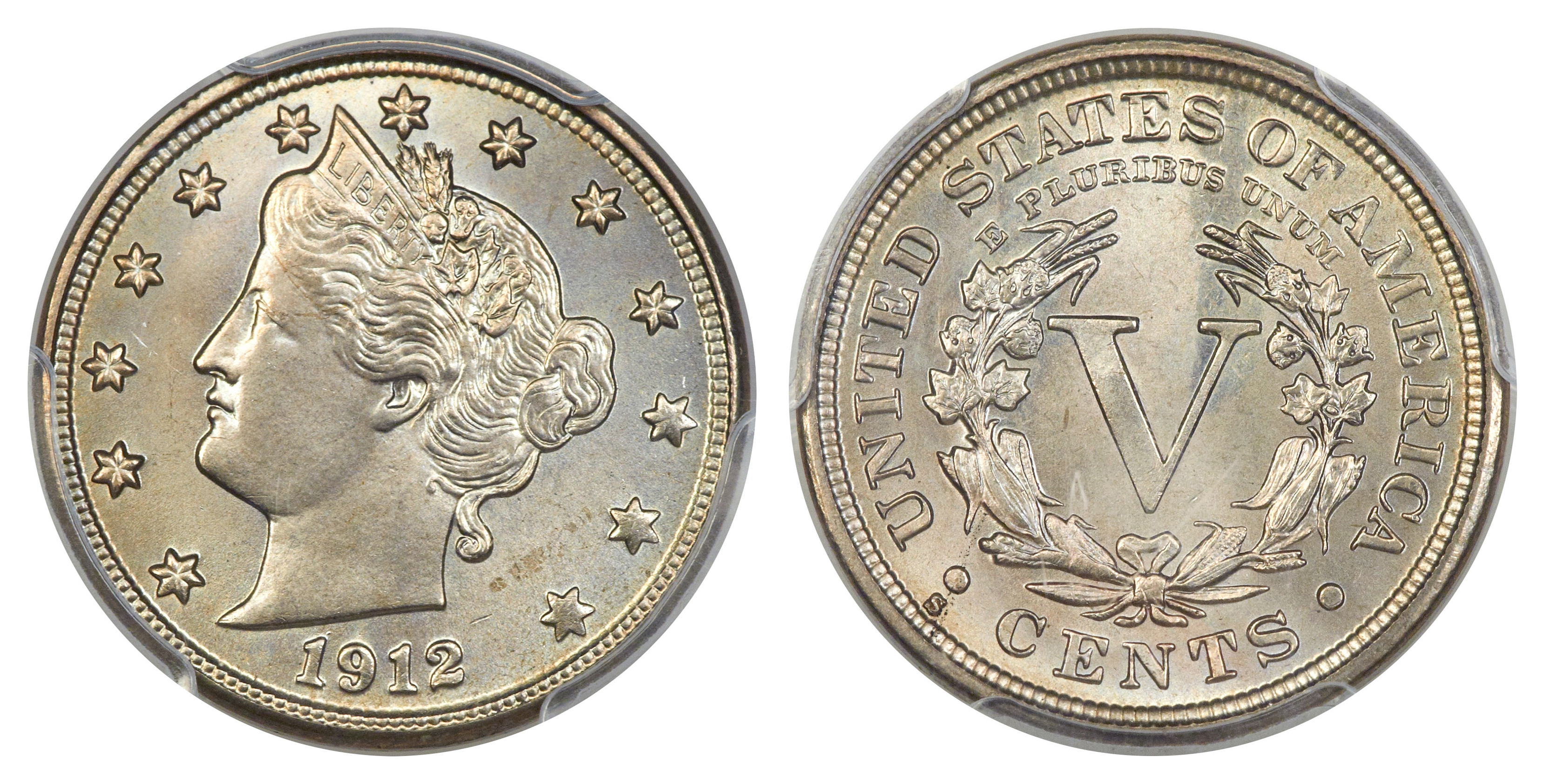
Heritage Auctions / U.S. Mint, Public Domain, via Wikimedia Commons
1912-S Liberty Head Nickel: The Lowest Mintage Regular Issue of the Series
The 1912-S Liberty Head Nickel holds a special place in American numismatic history. With only 238,000 pieces struck, it carries the lowest circulation mintage of any coin in the entire Liberty Head Nickel series, which ran from 1883 through 1912. That figure is even lower than any Buffalo Nickel or Jefferson Nickel ever struck for general circulation. Yet despite this genuine scarcity, the 1912-S is not classified as a key date by most numismatic references. Instead, it sits in a compelling sweet spot where strong collector demand meets limited supply to create a coin that rewards patient, well-informed buyers at virtually every grade level.
A Historic First for San Francisco
Before 1912, every nickel struck for general circulation came out of the Philadelphia Mint. The 1912-S changed that forever. Coinage at the San Francisco Mint began on December 24, 1912, making these the very first nickels ever produced at a branch mint facility. The Denver Mint also struck nickels for the first time that year in the form of the 1912-D, but the San Francisco issue carries the lower mintage of the two and commands the higher premium in today's market.
The timing matters for a reason beyond simple scarcity. By December 1912, the Liberty Head design had already lived out its intended run. The Buffalo Nickel, designed by sculptor James Earle Fraser, was waiting in the wings and would debut in early 1913. The 1912-S was thus not just the lowest-mintage Liberty Head Nickel ever struck for circulation. It was the final batch of coins struck by a branch mint in the Liberty Head era. That combination of last-of-its-kind status and genuinely small production numbers gives the coin a narrative appeal that raw mintage figures alone cannot convey.
Charles Barber and the Design
Charles Edward Barber was born in London in 1840 and came to the United States with his father William, who served as the fifth Chief Engraver of the United States Mint. Charles Barber succeeded his father in the role in 1879 and held the position until his death in 1917, making him one of the longest-serving Chief Engravers in mint history.
The Liberty Head Nickel debuted in 1883 in a design that Barber created under congressional mandate to replace the Shield Nickel. The obverse shows Liberty facing left, her hair swept back and tied in a bun, with a few loose curls falling along the back of the neck. She wears a coronet inscribed LIBERTY, with sprigs of wheat and cotton clustered at its base. Thirteen six-pointed stars circle inside the denticulated rim, and the date appears at the bottom.
The reverse centers on a bold Roman numeral V, surrounded by a wreath of cotton and corn tied at the bottom with a ribbon. The motto E PLURIBUS UNUM arches above the wreath. Around the outer border runs UNITED STATES OF AMERICA at the top and CENTS at the bottom, with two interpuncts flanking CENTS. The S mintmark for the San Francisco Mint appears in the small space just below the left-hand interpunct.
The coin's edge is smooth and plain, without any reeding. This was a deliberate design choice carried through the entire Liberty Head series and distinguishes it from later nickel designs.
Why Only 238,000 Pieces?
The relatively tiny production run at San Francisco in late 1912 reflects both the brief window available for striking and the economics of nickel production at the time. The mint received its coinage order, prepared dies, and began production less than two weeks before year end. There was simply not enough time or demand to justify a larger run.
Adding to the coin's complexity for collectors is the strike quality. PCGS has consistently noted that the 1912-S tends to show softness on the ear of corn at the left side of the reverse wreath. On many examples, this element is partially flat. On some pieces, it is completely missing. This weakness appears to be a consequence of differences in die preparation and press settings at the San Francisco facility compared to the long-established Philadelphia operation. Finding a sharply, fully struck 1912-S is genuinely difficult, and examples with complete reverse detail command substantial premiums even within certified grades.
The PCGS-NGC Controversy
The 1912-S became the center of a very public dispute between the two major grading services in the mid-2010s. Then-NGC Chairman Mark Salzberg published an open letter pointing out a striking population anomaly at PCGS. From the company's founding in 1986 through 2012, PCGS had graded just eight examples of the 1912-S at MS-66. But between 2012 and 2017, that census population climbed to nearly fifty coins at the same grade level, more than a sixfold increase in just five years.
Then-PCGS President Don Willis issued a public response, attributing part of the increase to the company's growing market share and citing the discovery of several original rolls of high-quality 1912-S nickels that yielded a cluster of gem-grade specimens. He also pointed out that populations naturally grow as more coins are submitted and re-submitted over time.
Whatever the explanation, the controversy underscores how carefully collectors need to track certified populations when buying in the upper grade ranges. Today, PCGS reports 50 coins at MS-66 and 10 at MS-66+. NGC has graded one coin at MS-66+ and none higher. CAC, which applies green stickers to coins that meet or exceed their assigned grades, reports zero stickered examples at MS-66+. The top of the market remains thin, which has supported strong auction prices for the finest known examples.
Value by Grade
The 1912-S is genuinely affordable across circulated grades, making it accessible to collectors building a complete Liberty Head Nickel date set on a reasonable budget. The price escalates meaningfully as you move into mint state territory, and sharply in the upper mint state grades.
| Grade | Approximate Value |
|---|---|
| Good (G-4) | $100 - $140 |
| Very Good (VG-8) | $130 - $165 |
| Fine (F-12) | $165 - $200 |
| Very Fine (VF-20) | $250 - $320 |
| Extremely Fine (EF-40) | $375 - $475 |
| About Uncirculated (AU-50) | $575 - $750 |
| AU-55 | $700 - $900 |
| Mint State (MS-60) | $950 - $1,200 |
| MS-62 | $1,100 - $1,500 |
| MS-63 | $1,400 - $1,800 |
| MS-64 | $2,000 - $2,600 |
| MS-65 | $3,000 - $4,200 |
| MS-66 | $4,500 - $6,500 |
| MS-66+ | $7,000 - $10,000+ |
Values reflect the retail market as of early 2026 and should be treated as reference ranges rather than guarantees. Problem-free coins with original surfaces and natural toning consistently bring premiums. Cleaned, polished, or otherwise altered examples sell at steep discounts regardless of visual appearance under casual examination.
Auction Highlights
Recent auction results provide useful data points for buyers and sellers. A PCGS MS-66+ example sold at Stack's Bowers in March 2020 for $7,200, and another crossed the block that August at $6,000 in a Gold Shield holder. Heritage Auctions realized $9,900 for a different PCGS MS-66+ example from the Scherr Family Collection in April 2020. At the MS-66 level, prices have generally ranged from $3,000 to $4,935 at major auction houses over the past several years, with the spread reflecting differences in eye appeal, strike quality, and toning characteristics.
These numbers hold up well over time. The market for the 1912-S has proven stable because the coin has real scarcity underpinning it, not just collector sentiment.
Identification Tips
The S mintmark is the starting point for any authentication of this coin. On the reverse, look just below the dot positioned to the left of CENTS. The S mark is small and requires at least 5x magnification to read clearly. It should be cleanly punched and properly positioned within that space.
Beyond the mintmark, several other characteristics help authenticate genuine examples:
Strike softness on the reverse corn ear. Nearly every authentic 1912-S shows some degree of weakness on the corn element at the left of the wreath. A coin that appears absolutely fully struck here requires careful review, though a handful of well-struck pieces do exist. Do not assume a fully struck coin is fake, but do verify all other diagnostic features carefully.
Originality of surfaces. Cleaned coins are far too common in this series. Under a loupe or microscope, look for hairline scratches moving uniformly across the fields, which are the telltale sign of cleaning with a soft cloth or chemical dip. Original mint luster flows in consistent directions related to the die lines and has an unbroken, satiny or frosty quality that cleaning destroys and cannot replicate.
Edge integrity. The plain smooth edge should be free of any reeding or tooling marks. Also check the entire coin edge for signs of alterations, since less ethical sellers have been known to alter mintmarks on cheaper coins.
Design details. The 1912-S follows the standard Barber design closely. All the stars should be complete and evenly spaced. The LIBERTY inscription on the coronet should be sharp in higher grades. The numerals in the date should show proper size and spacing for the 1912 punch used at San Francisco.
For any purchase at MS-64 and above, limiting yourself to PCGS or NGC certified examples is the practical standard. The difference in premiums between raw and certified coins at those grade levels is smaller than the risk of buying a problem coin.
Placing the 1912-S in Context
The Liberty Head Nickel series spans thirty years and dozens of date-and-mintmark combinations. For collectors building a complete set, the true keys are several of the very low mintage Philadelphia issues from the 1880s, including the 1879, 1880, and 1881 dates. These can cost several hundred to several thousand dollars even in circulated grades. The 1912-S is among the more affordable later dates in the series and benefits from a clear historical story.
Every serious collector of the series eventually confronts the five 1913 Liberty Head Nickels, the legendary unauthorized pieces struck by a mint employee. These are not official issues and are not part of a legitimate set, but they loom large over the series' history. Three have individually sold for more than $3 million each at auction. The 1912-S is, by contrast, the final authorized issue from any branch mint in the design's history, a coin you can actually own and enjoy.
Whether you are starting a Liberty Head Nickel set in circulated grades or searching for a high-grade gem to anchor an advanced registry set, the 1912-S deserves serious attention. It is a coin with a genuine story, verifiable scarcity, and a market that has proven consistent. The combination of historical firsts and measurable rarity makes it one of the more satisfying acquisitions in the entire American type coin landscape.
Storage and Care
Once you own a 1912-S, proper storage protects your investment. Nickel is relatively resistant to corrosion compared to silver, but it is not immune. Inert holders made from Mylar or polyethylene are appropriate for circulated examples. For mint state coins, the hard plastic slabs from PCGS or NGC provide both protection and authentication documentation in one package.
Avoid touching the coin's surfaces with bare fingers. Skin oils leave residue that can cause spotting over time, particularly on bright, original mint state pieces. Handle coins by the edges, and store them in a stable environment with moderate humidity. Temperature fluctuations cause expansion and contraction in holders that can eventually cause hairlines.
If you acquire a raw coin and find it appealing, resist the temptation to clean it even if it looks dull. Original, toned surfaces are what the market wants, and any attempt to brighten a coin generally destroys value. Professional conservation services can address specific problems like PVC contamination from old holders, but brightening or polishing always lowers collector value.
The 1912-S Liberty Head Nickel is a straightforward coin to collect intelligently if you follow these principles: buy certified for MS-64 and above, study auction records before setting a price target, and prioritize original surfaces over flashy appearance. Collectors who approach it this way almost always end up satisfied with their purchases.
Related Items
Have This Item?
Our AI appraisal tool is coming soon. Upload photos, get instant identification and valuation.
Get Appraisal