Liberty & Co. Tudric Pewter Clock (Archibald Knox, Art Nouveau)
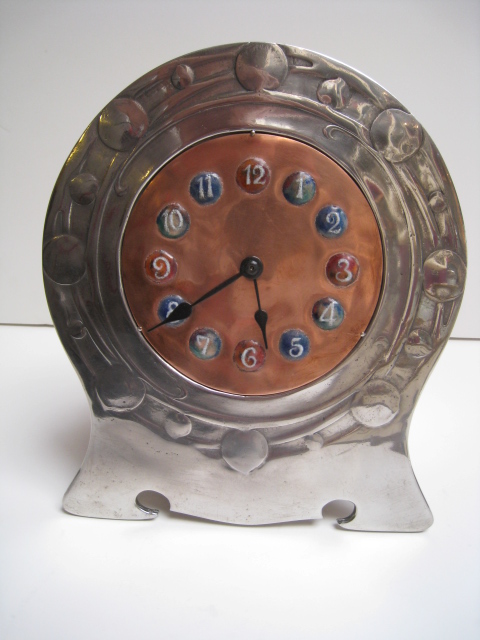
Photo by So-Nouveau, Public Domain, via Wikimedia Commons
Some objects stop you in your tracks. A Liberty & Co. Tudric pewter clock designed by Archibald Knox is one of them. With its flowing Celtic interlace, its marriage of handcraft sensibility and industrial production, and its unmistakable silhouette, a Tudric clock represents one of the high points of the Art Nouveau movement in the decorative arts. These pieces have been drawing collectors for over a century, and their appeal shows no sign of fading.
If you've spotted one at auction, inherited one from a relative, or simply fallen under the spell of Knox's sinuous, nature-inspired designs, this guide will walk you through everything you need to know: the history, the craftsmanship, what makes these clocks valuable, and how to tell a genuine example from a reproduction.
Archibald Knox: The Man Behind the Design
Archibald Knox (1864 to 1933) was born in Cronkbourne, near Douglas, on the Isle of Man. That detail matters enormously. The Isle of Man's ancient Celtic heritage, its carved stone crosses, illuminated manuscripts, and knotwork traditions, became the wellspring of Knox's entire artistic vocabulary.
Knox studied at the Douglas School of Art and later taught there before moving to London around 1897. He quickly established connections with some of the most progressive design retailers of the era, but it was his partnership with Liberty & Co. that would define his legacy.
Arthur Lasenby Liberty had founded his Regent Street shop in 1875, initially specializing in fabrics and goods from Japan and the East. By the turn of the century, Liberty & Co. had become the leading British retailer of progressive design, championing the Arts and Crafts movement and the emerging Art Nouveau style. Liberty was shrewd enough to recognize that the appetite for artistic metalwork far exceeded what could be produced by hand alone. He wanted designs that honored the Arts and Crafts aesthetic while being reproducible at a scale and price point that would reach a broad market.
Knox was the perfect designer for this vision. Between roughly 1899 and 1912, he created over 400 designs for Liberty's Tudric (pewter) and Cymric (silver) ranges. The Tudric line took its name from the Tudor dynasty, evoking a romanticized English past, while the material itself (pewter, an alloy of tin with small amounts of copper and antimony) was both affordable and beautifully suited to Knox's flowing organic forms.
The Tudric Clock Range
Knox designed several clock models for the Tudric range, and they are among the most coveted pieces in the entire line. Notable models include:
Model 0366: A tall, elegant clock with flowing Celtic interlace framing the dial. This is perhaps the most recognized Tudric clock design, with a distinctive arched top and sinuous knotwork columns.
Model 0721: A smaller carriage-style clock featuring enamel work on the dial face, often in characteristic blues and greens. These enameled examples are particularly rare and valuable.
Model 096/097: The cruciform clock, with a striking cross-shaped silhouette featuring abalone shell inlay. These are among the rarest and most dramatic of all Tudric clock designs.
The clocks typically house French or German movements (Lenzkirch movements are particularly common). The cases were cast in pewter and hand-finished, with Knox's designs translated from his original drawings by skilled craftsmen at the W.H. Haseler factory in Birmingham, Liberty's primary metalwork supplier.
What Makes Tudric Clocks Collectible
Several factors combine to make these objects intensely desirable:
Design Excellence: Knox's ability to translate ancient Celtic motifs into a modern Art Nouveau idiom was unmatched. His interlace patterns appear to grow organically from the form of the object itself, never merely applied as decoration. Each curve relates to the next in a continuous visual rhythm that rewards sustained looking.
Historical Significance: These clocks sit at a fascinating crossroads of design history. They represent the moment when Arts and Crafts idealism met industrial production, when the democratization of good design became a real commercial possibility. Liberty & Co. was the iconic British vehicle for this transformation.
Material Character: Pewter develops a beautiful, soft patina over time that enhances the sculptural qualities of Knox's designs. Unlike silver, which requires regular polishing, pewter's gentle aging is considered a virtue by most collectors.
Rarity: While Tudric pewterware was produced in reasonable numbers for everyday items (tea sets, vases, biscuit boxes), the clocks were always premium items produced in smaller quantities. Surviving examples with original movements, intact enamel, or abalone inlay are genuinely scarce.
Attribution: Knox's work for Liberty was initially anonymous (as was Liberty's policy for all its designers). The scholarly identification of Knox's specific designs is now well established thanks to the research of Stephen Martin, Adrian Tilbrook, and others. Authenticated Knox designs carry a substantial premium over unattributed Tudric pieces.
Condition Grading Guide
| Grade | Description | Typical Market Impact |
|---|---|---|
| Exceptional | All original: case, movement, dial, hands, enamel (if applicable). No dents, no repairs. Movement runs accurately. | Full market value, premium for provenance |
| Excellent | Original throughout with minor surface wear. Movement runs. Minimal patina variation. | 80-90% of top value |
| Very Good | Light wear, possible small dings or minor patina irregularities. Movement functional or easily serviceable. Original dial and hands. | 65-80% of top value |
| Good | Moderate wear, some dents or minor damage. Movement may need servicing. All major components present. | 45-65% of top value |
| Fair | Noticeable damage, possible missing hands or replacement movement. Enamel loss (on enameled models). Pewter repairs visible. | 25-45% of top value |
| Poor | Significant damage, missing components, heavy repairs, or recast sections. Decorative value only. | 10-25% of top value |
Authentication: What to Look For
The market for Tudric pewterware includes both genuine pieces and reproductions, so careful authentication is essential.
Stamped Marks: Genuine Tudric pieces are stamped on the underside with the word "TUDRIC" and a model number (three or four digits). Some pieces also carry "ENGLISH PEWTER" or "MADE IN ENGLAND" stamps. The stamping should look hand-applied, with slightly irregular depth and positioning. Machine-perfect stamps suggest a later reproduction.
Model Numbers: Cross-reference the model number with published catalogs and databases. Stephen Martin's book Archibald Knox (2001) is the essential reference, cataloging known designs with their model numbers and illustrations.
Construction Quality: Genuine Tudric pieces show the characteristics of sand-cast pewter: slight surface texture, minor casting irregularities on interior surfaces, and hand-finished details. The quality of the casting and finishing on authentic pieces is consistently high, even where minor imperfections exist.
Patina: A century-old pewter surface develops a distinctive gray patina with subtle tonal variation. Artificial aging (chemical treatments to make new pewter look old) tends to produce an even, flat gray without natural variation. Under magnification, genuine old pewter shows a complex surface microstructure that is extremely difficult to fake.
Movement Mounts: The clock movement should sit in its case in a manner consistent with the original design. Replacement movements that don't quite fit the case, shims or filler material around the movement, or non-period screws are all warning signs.
Enamel Work: On enameled Tudric clocks, the enamel should show age-appropriate characteristics: fine crazing, slight surface irregularities, and colors consistent with early 20th century enamel palettes. Modern enamel tends to be smoother and more uniformly colored.
Weight: Genuine Tudric pewter has a specific alloy composition that gives it a characteristic heft. Pieces that feel unusually light or heavy for their size warrant further investigation.
Market Value and Recent Auction Results
The market for Archibald Knox Tudric pewterware has been robust, with clocks consistently ranking among the most valuable items in the range.
Standard Tudric clocks (attributed to Knox, good condition): $1,500 to $4,000.
Exceptional examples (Model 0366 or similar, excellent condition): $4,000 to $8,000.
Rare variants (cruciform models with abalone, enameled carriage clocks): $6,000 to $15,000 or more at major auction houses.
At Lyon & Turnbull's "Design Since 1860" sale in April 2023, a Knox cruciform clock (Model 097) with abalone inlay attracted significant interest. Carter's price guide documents Tudric pewter clock values ranging from approximately $200 for damaged examples up to $4,261 for exceptional pieces. At LiveAuctioneers, over 1,800 Archibald Knox items have sold at auction, confirming strong and sustained collector interest.
General Tudric pewterware (non-clock items) without specific Knox attribution trades in a much lower range, from $28 to $500, which underscores the dramatic premium that Knox designs and clock forms command.
Buying Advice
Prioritize condition over price. A clean, undamaged Tudric clock in excellent condition will appreciate faster and sell more easily than a bargain piece with issues.
Verify the model number. Not all Tudric pewterware was designed by Knox. Pieces confirmed as Knox designs carry a significant premium, so authentication matters enormously.
Check the movement. A working original movement adds substantial value. If the movement has been replaced, this should be reflected in the price. French and Lenzkirch movements appropriate to the period are acceptable; modern quartz movements are not.
Consider provenance. Documented ownership history, exhibition records, or inclusion in published references all enhance value.
Handle before buying. If possible, examine the piece in person. Photographs can conceal condition issues, and the tactile quality of genuine old pewter is distinctive once you've handled several examples.
Displaying and Caring for Your Tudric Clock
Proper care ensures these century-old objects survive for another hundred years.
Placement: Display your Tudric clock away from direct sunlight, which can accelerate patina changes and potentially damage enamel work. A stable, vibration-free surface is ideal. Avoid placing the clock near heat sources, radiators, or air conditioning vents, as temperature fluctuations can stress the metal.
Cleaning: Pewter should generally not be polished to a bright shine. The soft, matte patina is part of the charm and a sign of genuine age. If cleaning is necessary, use only warm water with a tiny amount of mild soap, dry immediately, and avoid abrasive materials of any kind. Never use silver polish on pewter.
Movement Maintenance: If the clock has a working mechanical movement, have it serviced by a qualified horologist every five to seven years. A specialist familiar with French or German carriage movements from this period is ideal. Do not attempt to oil the movement yourself, as improper lubrication can cause more damage than neglect.
Insurance: Given the values involved, ensure your Tudric clock is specifically listed on your homeowner's or renter's insurance policy with an up-to-date appraisal. Photograph the piece thoroughly (including the base stamps and any maker's marks) for your records.
The Broader Liberty & Co. Collecting World
A Tudric clock often becomes the gateway piece for a broader collection of Liberty & Co. metalwork. The Tudric range includes candlesticks, tea sets, trays, vases, photograph frames, inkwells, and biscuit boxes, many designed by Knox but others by talented contemporaries including Oliver Baker and Rex Silver.
The Cymric range (Liberty's silver line) features many of the same Knox designs executed in sterling silver, often with enamel and semi-precious stone embellishments. Cymric pieces are considerably rarer and more expensive than their Tudric counterparts, but the design language is closely related.
For collectors on a more modest budget, Tudric tea wares and small accessories by unidentified designers can still be found for a few hundred dollars, providing an entry point into this fascinating corner of decorative arts history. Building a collection around a central masterpiece like a Knox clock, supplemented by smaller pieces that illustrate the range of the Tudric line, creates a cohesive and visually compelling display.
Knox's Lasting Influence
Archibald Knox's work for Liberty & Co. represents something rare in the decorative arts: a genuinely successful marriage of artistic vision and commercial production. His designs proved that beauty and affordability were not mutually exclusive, that ancient Celtic traditions could speak powerfully in a modern context, and that everyday objects could aspire to the condition of art.
Today, a Tudric pewter clock by Knox serves as both a functional timepiece and a sculptural object of real distinction. It connects its owner to the flowering of Art Nouveau in Britain, to the progressive retail vision of Liberty & Co., and to the creative genius of a designer from the Isle of Man whose flowing lines continue to captivate more than a century after they were first conceived.
Related Items
Have This Item?
Our AI appraisal tool is coming soon. Upload photos, get instant identification and valuation.
Get Appraisal