Josef Hoffmann Kubus Sofa (Wittmann, 1910 Original Design)
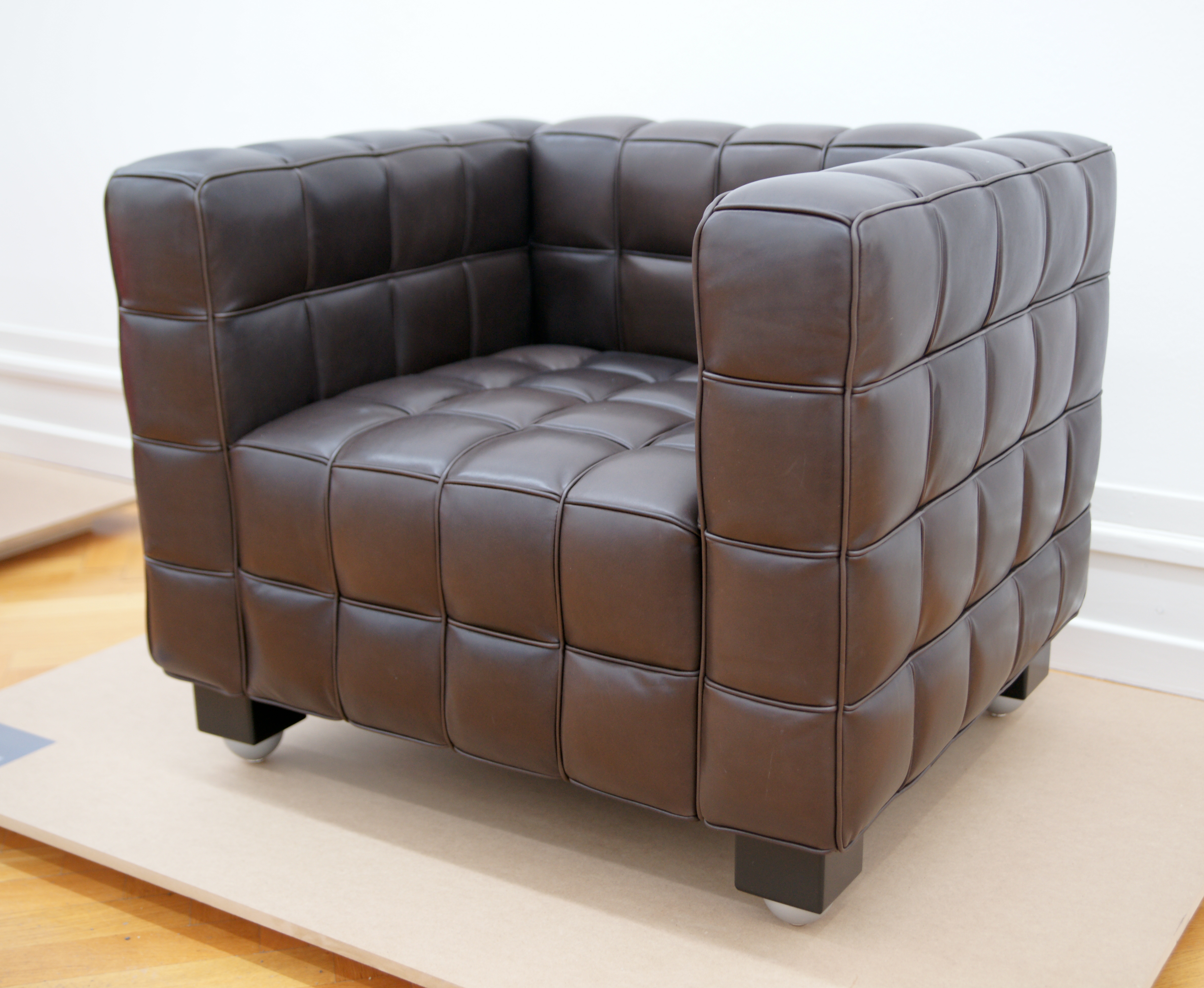
Photo of Kubus Fauteuil produced by Wittmann, 2010. Wikimedia Commons, CC BY-SA 3.0.
Few pieces of furniture can claim to have defined an entire movement in design. The Josef Hoffmann Kubus sofa, first conceived in 1910 and produced by the Austrian manufacturer Wittmann, stands as one of the most striking examples of early modernist furniture ever created. With its radical cubic geometry, hand-quilted leather cushions, and total rejection of ornamental excess, the Kubus challenged every assumption about what a sofa could be. More than a century later, it remains in production, a testament to a design so ahead of its time that the world still has not caught up.
The Man Behind the Cube
Josef Hoffmann (1870 to 1956) was born in Brtnice, Moravia, in what was then the Austro-Hungarian Empire. Trained at the Academy of Fine Arts in Vienna under the legendary Otto Wagner, Hoffmann became one of the founding members of the Vienna Secession in 1897 and, more importantly for furniture collectors, co-founded the Wiener Werkstatte (Vienna Workshop) in 1903 alongside Koloman Moser and the industrialist Fritz Waerndorfer.
The Wiener Werkstatte was a radical experiment in total design. Hoffmann and his collaborators believed that every element of a living space, from the architecture down to the cutlery, should be conceived as a unified artistic statement. This philosophy of Gesamtkunstwerk (total work of art) drove Hoffmann to design everything from buildings to brooches, always guided by a rigorous commitment to geometric purity.
By 1910, Hoffmann had already completed some of his most celebrated architectural works, including the Purkersdorf Sanatorium (1904) and the Stoclet Palace in Brussels (1905 to 1911), a building widely regarded as one of the finest examples of Art Nouveau architecture. It was during this extraordinarily productive period that he designed the Kubus.
Hoffmann's nickname among Viennese artistic circles was "Quadratl-Hoffmann" (Square Hoffmann), a playful reference to his obsessive use of the square motif across all his work. From metalwork to textiles to architecture, the square and the grid were Hoffmann's fundamental vocabulary. The Kubus represents the ultimate expression of this obsession.
The Birth of the Kubus
The Kubus (German for "cube") was designed in 1910 for exhibition at the International Hunting Exhibition in Vienna, though some sources connect it to the 1910 World Exhibition in Buenos Aires. The design is deceptively simple: a series of square leather cushions arranged in a strict grid pattern, supported by a minimal frame of black-lacquered beechwood resting on small hemispherical feet.
What made the Kubus revolutionary was its total commitment to the square as a design motif. Every surface, every cushion, every proportion references the cube. There are no curves, no carved details, no concessions to the organic or the decorative. In a world where sofas were still routinely adorned with tufting, fringe, and carved wood, the Kubus was almost aggressively modern.
The design was also remarkably forward-thinking in its construction. Each cushion is individually stuffed and hand-quilted, then assembled onto the frame. This modular approach anticipated many of the principles that would later define modern furniture manufacturing.
Contemporary critics were divided. Some saw the Kubus as a bold statement of pure design. Others found it cold, almost brutalist in its refusal to comfort the eye with familiar decorative elements. Time, of course, has sided firmly with Hoffmann. The Kubus is now recognized as a precursor to the geometric designs of the Bauhaus, De Stijl, and mid-century modernism.
Wittmann: The Only Authorized Producer
The story of the Kubus is inseparable from Wittmann Mobelwerkstatten, the Austrian furniture manufacturer that has been the exclusive licensed producer of Hoffmann's furniture designs since 1960. Founded in 1896, Wittmann operates from a workshop in Etsdorf am Kamp in Lower Austria, where each Kubus is still handcrafted using traditional techniques.
Wittmann produces the Kubus in several configurations: a single armchair (the Kubus Fauteuil), a two-seat sofa, and a three-seat sofa. The upholstery is offered in a range of premium leather colors, from classic black to cognac brown, white, and various custom options. Each piece takes approximately 80 hours of skilled handwork to complete, and every unit bears a numbered certificate of authenticity.
The manufacturing process begins with the selection of premium full-grain cowhide, which is inspected for imperfections before cutting. The leather squares are cut to precise dimensions, hand-stuffed with a proprietary filling material, and then individually quilted before being mounted onto the kiln-dried beechwood frame. The feet, those distinctive small hemispheres, are lathed and finished by hand.
The relationship between Hoffmann's estate and Wittmann is critical for collectors. Only pieces manufactured by Wittmann carry legitimate provenance. While various unlicensed reproductions exist (particularly from Italian and Chinese manufacturers), these lack the build quality, materials, and historical connection of genuine Wittmann production.
What Makes the Kubus Collectible
Several factors drive the Kubus's value in the secondary market:
Historical significance. The Kubus is one of the earliest examples of modernist cubic furniture, predating the Bauhaus movement by nearly a decade. It sits at the crossroads of Art Nouveau and Modernism, making it a pivot point in design history.
Continuous production. Unlike many design classics that went out of production for decades, the Kubus has been in near-continuous production since the 1960s. However, earlier Wittmann examples (1960s through 1980s) command premium prices due to their age and the patina of their leather.
Build quality. Genuine Wittmann Kubus pieces are built to last generations. The leather ages beautifully, developing character over decades of use.
Museum presence. The Kubus is held in the permanent collections of major design museums worldwide, including the MAK in Vienna, the Vitra Design Museum, and the Museum of Modern Art in New York. This institutional recognition supports long-term collectibility.
Scarcity of vintage examples. While the Kubus is still produced today, vintage examples from the 1960s, 1970s, and 1980s are relatively scarce on the secondary market, particularly in good condition.
Value Guide by Condition and Era
| Condition / Era | Armchair | Two-Seat Sofa | Three-Seat Sofa |
|---|---|---|---|
| New (current Wittmann production) | $6,000 - $9,000 | $10,000 - $15,000 | $14,000 - $20,000 |
| Excellent vintage (1980s-1990s Wittmann) | $4,000 - $7,000 | $7,000 - $12,000 | $10,000 - $16,000 |
| Good vintage (1960s-1970s Wittmann) | $5,000 - $10,000 | $9,000 - $18,000 | $14,000 - $25,000 |
| Fair vintage (wear, patina, minor damage) | $2,500 - $5,000 | $4,000 - $8,000 | $6,000 - $12,000 |
| Unlicensed reproduction | $500 - $2,000 | $1,000 - $3,000 | $1,500 - $4,000 |
Prices reflect recent sales on 1stDibs, Invaluable, and major European auction houses. Early Wittmann production from the 1960s and 1970s can command significant premiums when accompanied by original documentation.
Authentication: What to Look For
Identifying a genuine Wittmann Kubus requires attention to several key details:
The Wittmann label. Authentic pieces carry a Wittmann manufacturer's label, typically found on the underside of the frame or tucked between cushions. Older pieces may have different label styles, but the Wittmann name should always be present.
The numbered certificate. Modern Wittmann production includes a numbered certificate of authenticity. While older pieces may have lost their certificates over the decades, the presence of one significantly boosts value.
Leather quality. Wittmann uses premium full-grain leather. The stitching should be precise and even, with no loose threads or irregular spacing. The quilted squares should be uniform in size and padding.
Frame construction. The beechwood frame should be solid and well-joined. The hemispherical feet are a distinctive detail. Reproductions often use different foot styles or cheaper materials.
Weight. A genuine Wittmann Kubus is surprisingly heavy. The combination of solid beechwood and dense leather construction gives it a substantial heft that cheaper reproductions cannot match.
Proportions. The Kubus follows strict geometric ratios. The cushion squares should all be identical in size, and the overall proportions should feel perfectly balanced. Even slight deviations suggest a reproduction.
Condition Considerations
When evaluating a vintage Kubus, pay attention to:
Leather patina. Some patina is desirable on vintage pieces and adds character. However, deep cracks, tears, or areas of significant color loss will reduce value substantially.
Cushion firmness. Over decades of use, cushions may lose their shape. Refilling or replacing cushions is possible through Wittmann but adds cost.
Frame integrity. Check for wobble or looseness in the joints. A well-maintained frame should still feel solid after decades.
Color consistency. On black leather examples, look for areas where the dye has faded or shifted. Cognac and brown examples tend to age more gracefully.
Original versus replaced parts. Some vintage examples have had cushions reupholstered or feet replaced. While this does not disqualify a piece, original components in good condition are always preferred by collectors.
Notable Sales and Auction Results
At major auction houses, the Kubus has delivered consistently strong results. A black leather two-seat Kubus sofa from 1980s Wittmann production sold at Dorotheum in Vienna for approximately EUR 8,500 in 2022. On 1stDibs, dealers regularly list cognac leather examples from the 1980s in the $8,000 to $14,000 range, with pristine three-seat sofas occasionally reaching above $20,000.
The most sought-after examples tend to be matching sets. A pair of Kubus armchairs with a matching sofa, all from the same production period and in the same leather color, can command a premium of 30% to 50% over the combined value of individual pieces.
Market Outlook
The market for Josef Hoffmann furniture, and the Kubus in particular, has shown steady appreciation over the past two decades. Several factors support continued growth:
The broader market for Viennese Secession and Wiener Werkstatte design objects has been strong, driven by major museum exhibitions and growing academic interest. The MAK (Museum of Applied Arts) in Vienna has helped raise the profile of Hoffmann's work through dedicated exhibitions and publications.
New production prices from Wittmann continue to rise, which naturally lifts the secondary market for vintage pieces. The current retail price for a new Kubus three-seat sofa exceeds $18,000, making well-preserved vintage examples an attractive alternative.
The Kubus also benefits from its visual appeal in digital media. Its bold, geometric aesthetic photographs extremely well, making it popular with interior designers and architecture publications. This visibility drives demand from a younger generation of collectors who might not otherwise seek out early 20th-century furniture.
For collectors considering an entry point, the Kubus armchair offers the most accessible price and the smallest footprint, making it suitable even for modest spaces. For those with both the budget and the room, a matching pair of armchairs or a full sofa-and-chair set represents the most desirable configuration.
A Century of Geometry
The Kubus sofa is more than a piece of furniture. It is a manifesto in leather and wood, a declaration that beauty can emerge from pure geometry without a single decorative flourish. Josef Hoffmann proved in 1910 that a cube, repeated with discipline and executed with craft, could become one of the most compelling objects ever to occupy a living room. That the Kubus remains in continuous production more than 115 years later is perhaps the most powerful endorsement any design can receive.
Explore More: Browse all Antiques and Decorative Arts →
Related Items
Have This Item?
Our AI appraisal tool is coming soon. Upload photos, get instant identification and valuation.
Get Appraisal