1893 Columbian Exposition $1-$5 Stamp Set
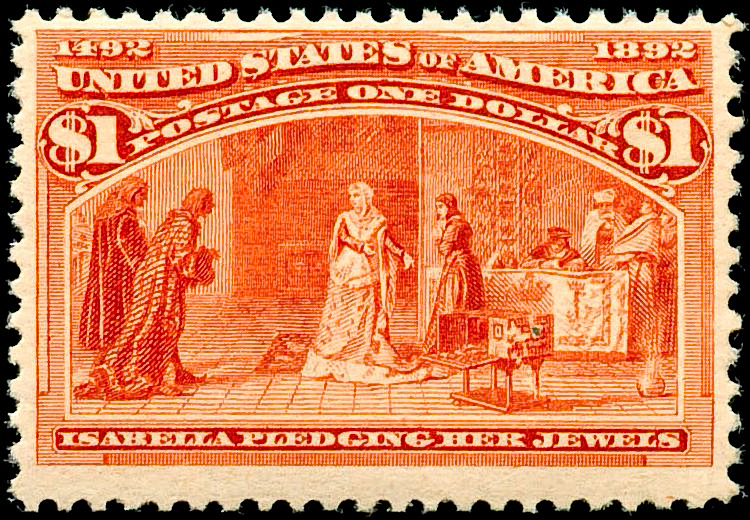
Gwillhickers via Wikimedia Commons, Public Domain (U.S. Post Office)
Quick Value Summary: Dollar-Value Columbians (Scott #241-245)
Scott # Denomination Design Used (F-VF) Mint Hinged (F-VF) Mint NH (F-VF) 241 $1 Isabella Pledging Her Jewels $350 - $600 $550 - $1,100 $2,200 - $3,500 242 $2 Columbus in Chains $400 - $650 $600 - $1,100 $2,500 - $4,000 243 $3 Columbus Describing Third Voyage $700 - $1,100 $1,200 - $2,000 $4,500 - $7,000 244 $4 Isabella and Columbus $900 - $1,500 $1,500 - $2,750 $5,500 - $9,000 245 $5 Portrait of Columbus $1,000 - $1,600 $1,500 - $2,500 $5,000 - $8,000 Complete $1-$5 set $3,350 - $5,450 $5,350 - $9,450 $19,700 - $31,500 Prices based on 2024-2025 Scott catalog values and recent auction results. Centering, freshness, and gum condition significantly affect value. Never-hinged (NH) examples command 2x-3x hinged prices for this era.
America's First Commemorative Stamps
Before 1893, the United States had never issued a commemorative postage stamp. Every stamp the country produced served a purely functional purpose: pay the postage, mail the letter. That changed on January 2, 1893, when the Post Office released a set of 16 stamps honoring the World's Columbian Exposition in Chicago. It was a set that angered collectors, delighted speculators, and ultimately became one of the most important issues in all of American philately.
The Columbian Issue, as collectors call it, depicted scenes from the life of Christopher Columbus. It ranged from a humble 1-cent stamp showing "Columbus in Sight of Land" up to a staggering $5 stamp bearing Columbus's portrait. That $5 denomination was unprecedented. No American stamp had ever cost more than 90 cents. The complete set carried a face value of $16.34, roughly equivalent to $390 in today's money. For a working-class American in 1893, that was weeks of wages spent on postage stamps.
The five dollar-value stamps ($1, $2, $3, $4, and $5) are the crown jewels of the series. They were produced in small quantities, bought primarily by collectors and speculators rather than postal customers, and today command prices ranging from several hundred to several thousand dollars depending on condition.
The Political Story
The Columbian stamps were born from a collision of commerce, politics, and the growing hobby of stamp collecting.
The American Banknote Company held the contract for U.S. stamp production. Postmaster General John Wanamaker (yes, the department store magnate) negotiated a special contract for the Columbian stamps without competitive bidding. American Banknote charged 17 cents per thousand stamps, more than double the 7.45 cents per thousand they charged for regular stamps. Their justification was that the Columbians were physically larger than standard stamps (roughly double the size), but critics saw it as profiteering.
The backlash was real. A group calling itself the "Society for the Suppression of Speculative Stamps" organized in protest, arguing that the Exposition wasn't significant enough to warrant commemorative stamps and that the Post Office was cynically exploiting collectors. The Chicago Tribune ridiculed the $5 stamp, noting that its only practical postal use would be mailing a 62.5-pound package of books at the book rate.
When Grover Cleveland returned to the presidency in March 1893, his new Postmaster General, Wilson Bissell, tried to renegotiate the contract on terms more favorable to the government.
Despite the controversy, the stamps sold. The American Banknote Company printed more than 2 billion Columbian stamps with a total face value exceeding $40 million. But the high-denomination stamps sold in far smaller numbers. Many were purchased by speculators who expected quick profits, and when values didn't immediately skyrocket after the stamps were withdrawn from sale on April 12, 1894, a glut of dollar-value Columbians hit the secondary market.
The Dollar Values: Stamp by Stamp
$1 Isabella Pledging Her Jewels (Scott #241)
The $1 stamp shows Queen Isabella offering her jewels to finance Columbus's voyage, based on a painting by Antonio Munoz Degrain. This was the first U.S. stamp to break the one-dollar barrier. Robert Savage handled the engraving.
The stamp's subject is somewhat mythical. The story of Isabella pawning her crown jewels to fund Columbus is dramatic but historically questionable. Most scholars believe Ferdinand and Isabella used treasury funds and profits from their recently concluded war against the Moors. But it made for a compelling stamp design.
Mintage/Sales: Approximately 55,000 to 60,000 sold before the remaining stock was destroyed.
Current values: Used examples in Fine to Very Fine condition sell at auction for $250 to $600, depending on centering and cancel quality. A neatly cancelled, well-centered example graded VF-80 by PSE brought $550 at a 2015 Kelleher auction. Mint hinged examples with original gum in Fine to Very Fine condition catalog at $1,100 (Scott 2025) and typically sell for $345 to $604 at auction. Never-hinged examples are scarce for this era and command significant premiums.
$2 Columbus in Chains (Scott #242)
This is many collectors' favorite stamp in the entire set. It depicts Columbus in shackles, facing charges of administrative misconduct after his arrest in Santo Domingo by Francisco de Bobadilla. The image was derived from a painting by Emanuel Leutze (the same artist who painted "Washington Crossing the Delaware").
There's something compelling about a nation honoring an explorer by putting him on a stamp in chains. It's an honest, unflinching moment that gives the Columbian Issue more depth than a simple celebration would have.
Mintage/Sales: Approximately 45,000 sold.
Current values: Used examples in Fine to Very Fine condition bring $400 to $650. Mint hinged examples catalog around $1,100 (Scott 2025). The $2 value tends to trade at prices similar to the $1 in lower grades but can command a small premium due to its striking design.
$3 Columbus Describing Third Voyage (Scott #243)
The $3 shows Columbus describing his third voyage, based on a painting by Francisco Jover y Casanova (the same artist whose work appears on the 8-cent value). Robert Savage engraved this design as well.
Mintage/Sales: Only 27,650 were printed, making this the second-scarcest denomination in the series. Even fewer were actually sold.
Current values: This is where prices start climbing noticeably. Used examples in Fine to Very Fine condition sell for $700 to $1,100. Mint hinged examples catalog around $1,600 to $2,000. A color variety exists: the normal color is yellow green, but a variant in olive green (awarded a minor Scott number listing) brings a modest premium.
$4 Isabella and Columbus (Scott #244)
This stamp holds a special place in U.S. philatelic history: it was the first American stamp to feature a woman's portrait. Queen Isabella appears alongside Columbus, with the Columbus portrait adapted from a work by Lorenzo Lotto.
Mintage/Sales: Just 26,350 printed, the lowest quantity of any Columbian stamp. This is the key stamp of the dollar values.
Current values: Used examples in Fine to Very Fine condition sell for $900 to $1,500. Mint hinged examples catalog at $2,500 to $2,750 (Scott 2025). Like the $3, a color variety exists: the normal crimson lake versus a rose carmine variant.
$5 Portrait of Columbus (Scott #245)
The highest denomination in the set features a portrait of Columbus engraved by Alfred Jones. Jones also engraved the Columbian Exposition half dollar coin, and interestingly, the two portraits face opposite directions. The two framing figures were engraved by Charles Skinner.
Mintage/Sales: 27,350 were printed, of which only 21,844 were actually sold. The rest were destroyed when the issue was withdrawn.
Current values: Used examples in Fine to Very Fine condition bring $1,000 to $1,600. The Scott 2025 catalog lists used value at $1,150 for Fine. Mint hinged examples catalog at $2,500 and up. Despite having a slightly higher print run than the $4, the $5 commands similar or higher prices due to its status as the top value in America's first commemorative set.
Condition and Grading: What Matters
For stamps from the 1890s, condition variables are different from modern stamps. Here's what drives value:
Centering: The Columbians were printed in sheets of 200 (divided into two panes of 100). Centering varies considerably. Well-centered examples with roughly equal margins on all sides (Very Fine or better) command substantial premiums over off-center examples. An otherwise identical stamp can be worth 50% more with VF centering versus Fine centering.
Gum condition: For mint stamps, the original gum is crucial. Lightly hinged (a single small hinge mark) is acceptable and standard for this era. Heavy hinge remnants or disturbed gum reduce value by 25-40%. Never-hinged examples are genuinely rare for 1890s stamps and command 2x to 3x the hinged price. Regummed stamps (where the original gum was removed and new gum applied) are worth roughly 40-50% of original gum price.
Perforations: The Columbians are known for variable perforation quality. Some stamps have clean, well-aligned perfs. Others have rough, misaligned, or partially blind perforations. Scholars believe this inconsistency may be because the Bureau of Engraving and Printing finished some sheets that American Banknote had started, and the Bureau's early perforation work was substandard. Stamps from the top and bottom rows of each pane may have straight edges (no perforations on one side), since 10 out of every 200 stamps had this feature. Straight-edge examples are worth 20-40% less than fully perforated copies.
Color: Fresh, bright color commands premiums. The dollar values in particular can show fading or oxidation. The $1 in deep salmon, the $3 in bright yellow green, and the $5 in rich black are especially desirable when the color is strong.
Authentication and Fakes
The dollar-value Columbians are valuable enough to attract forgers, but the primary concerns are:
Regumming: Far more common than outright fakes. Many collectors removed original gum decades ago (a common practice), and some stamps have been regummed to simulate original gum. An expert opinion certificate from the Philatelic Foundation (PF) or Professional Stamp Experts (PSE) is worth the $25 to $50 investment for any stamp worth over $500.
Reperforation: Straight-edge stamps (from the sheet margins) have been reperforated to appear fully perforated. Check for consistent perforation gauge and alignment compared to the other three sides.
Color changelings: Chemical alteration of stamp colors to simulate scarcer varieties (like the $3 olive green or $4 rose carmine). Expert certification catches these.
Outright forgeries: Less common for U.S. classics than for some foreign stamps, but they exist. The engraving quality of genuine Columbians is extremely high, and most forgeries fail to replicate the fine detail. Compare any questionable stamp against high-resolution images from the Smithsonian's National Postal Museum collection.
Where to Sell Dollar-Value Columbians
Auction houses (for sets or high-grade singles): Robert A. Siegel Auction Galleries, Daniel F. Kelleher Auctions, and H.R. Harmer are the top U.S. stamp auction firms. Seller's commissions are typically 10-15%, and these houses attract the most knowledgeable buyers. For a complete $1 to $5 set in presentable condition, auction is the way to maximize your return.
Dealers: Major stamp dealers will buy dollar-value Columbians at 50-70% of retail/catalog value. This is the quickest route to cash but not the most profitable. For individual stamps worth under $1,000, a dealer may be more practical than consigning to auction.
eBay and HipStamp: Online platforms work for mid-range stamps ($200 to $1,000). eBay charges approximately 13% in fees. HipStamp charges lower fees (around 6-8%) but has a smaller audience. Always provide clear, high-resolution scans of both front and back, and mention any certificates or expert opinions.
Stamp shows: The American Stamp Dealers Association (ASDA) runs regular shows where you can get offers from multiple dealers. The World Stamp Show (held every decade) is the largest venue but regular regional shows work well too.
Building the Set
If you're collecting the dollar-value Columbians, here's practical advice:
Start with the $1 and $2 in used condition. These are the most affordable entry points at $250 to $650 each. Used stamps are sometimes more attractive than cheap mint examples with problems (thins, tears, heavy cancels).
Add the $5 next, since it gets the most attention as the series capstone. Then fill in the $3 and $4.
For a used set in Fine to Very Fine condition, budget $3,350 to $5,450. For a mint hinged set in similar grades, expect $5,350 to $9,450. A never-hinged set is a five-figure pursuit that could easily reach $20,000 to $30,000 or more.
Patience pays. These stamps appear at auction regularly, and prices can vary significantly based on the specific auction, the day, and the competition in the room.
Related Items
Have This Item?
Our AI appraisal tool is coming soon. Upload photos, get instant identification and valuation.
Get Appraisal