1869 24-Cent Declaration of Independence (Scott #120)
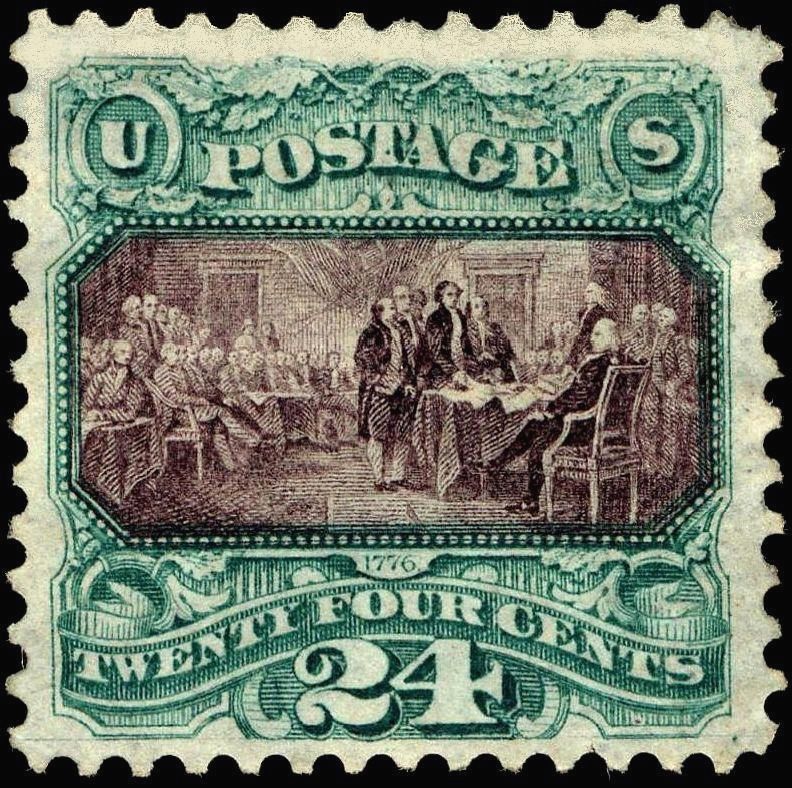
1869 24-cent Declaration of Independence stamp, National Bank Note Company. Public domain.
1869 24-Cent Declaration of Independence (Scott #120): America's First Pictorial Stamp MasterpieceThe 1869 Pictorial Issue occupies a singular place in American philatelic history, and within that set, the 24-cent Declaration of Independence (Scott #120) stands apart as one of the finest examples of engraving ever produced for a postage stamp. Printed in two colors -- green for the frame and violet for the center -- on hard wove paper with the characteristic G grill, this stamp represents the ambitions of an era when the United States Post Office wanted its stamps to reflect the grandeur of the young nation's history.### The 1869 Pictorial Issue: An Ambitious VisionBy early 1868, the stamps that had been in use for over six years were showing their age, and the printing plates had worn significantly. The Post Office solicited new bids for a definitive series and expressed a clear preference for something historically ambitious. The guidelines suggested honoring the history of the Post Office itself and "the most important scenes in the early history of the country."The National Bank Note Company won the contract and delivered something genuinely unprecedented: America's first pictorial stamp issue, released primarily on March 19, 1869. The series used scenes from American history for the higher denominations and portrayed transportation themes for lower values -- a post horse rider (2 cents), a locomotive (3 cents), and a steamship (12 cents) before transitioning to historical subjects for the 15 cents and above.The public and press were not impressed initially. Critics called the stamps "neither historical, national, [nor] beautiful." Political opponents of the National Bank Note Company, particularly its competitor Butler Carpenter, actively worked to discredit the series. The controversy contributed to the stamps being withdrawn from sale within a year of their release -- an unusually short production run that significantly limited quantities issued.That short production window is a central reason why the 1869 Pictorials are collected so seriously today. With only 248,925 examples of the 24-cent stamp issued, combined with the normal attrition of 155 years of existence, genuine examples in excellent condition are not easy to find.### The Design: A Miniature MasterpieceThe 24-cent stamp depicts the Signing of the Declaration of Independence, based on John Trumbull's famous 1817 painting of the same scene. What makes this stamp extraordinary from a technical standpoint is the engraving work by James Smillie. He rendered 42 figures in the scene, and according to philatelic tradition, the six principal signers can be identified under a magnifying glass. The level of detail packed into a stamp that measures roughly 22mm by 26mm is remarkable.The stamp is printed in two colors. The outer frame -- a rectangular border with "U.S. POSTAGE" at top and "24 CENTS" at bottom -- is in green. The center vignette showing the Declaration scene is in violet (often described as purple in older literature). This bicolor printing required two separate printing passes, with careful registration needed to align the two elements correctly.When registration failed -- when the paper shifted between the first and second printing runs -- the result was an invert: a stamp where the center is printed upside down relative to the frame. The 24-cent inverted center (Scott #120b) is one of the most celebrated errors in American philately. Only a handful of examples are known to exist, and when one comes to market, it generates significant attention and extremely high prices. The standard non-inverted #120 and the inverted #120b share the same Scott number base but exist in completely different value tiers.### The G GrillAll 1869 Pictorial stamps feature the G grill, which distinguishes them from earlier and later issues. The grill is a pattern of small pyramid-shaped indentations pressed into the stamp paper by a roller. Its purpose was practical: the grilling was intended to break up the paper fibers so that cancellation ink would penetrate deeply, making it harder to wash off a cancel and reuse the stamp.The G grill is finer than earlier grills used on 1860s American stamps. Under magnification, it appears as a regular pattern of small points pressed into the paper. The presence and condition of the grill is an important factor in evaluating and grading 1869 stamps.### Condition and GradingThe 1869 24-cent stamp presents multiple grading challenges that serious collectors should understand:Centering: Like all 19th-century stamps, centering on the #120 is highly variable. The stamps were perforated after printing, and the alignment was imprecise by modern standards. A well-centered #120 with four approximately equal margins is significantly more desirable than the same stamp with a shifted design or noticeably unequal margins. The Scott catalog and grading services reward centering heavily.The grill: The G grill should be present and reasonably complete. Grills were sometimes applied unevenly or partially, and stamps with missing or incomplete grills grade differently than those with clean, complete grills.Perforation integrity: The perforations on 1869 stamps are 12-gauge. Complete, intact perforations without short or pulled perfs are the standard for higher-grade examples. Because these stamps are over 155 years old, perf faults are common.Paper quality: The hard wove paper used for these stamps can show various forms of aging: toning, thins (where the paper has been thinned, often from hinge removal), creases, and soiling. A stamp with any of these issues will grade lower than a fresh, clean example.Color intensity: The green and violet colors should be clear and bright. Faded or oxidized colors reduce visual appeal and grade.Cancels: Used copies carry postal cancels. Period cancels that are light and do not obscure the design are preferred. Heavy, manuscript, or "socked on nose" cancels that cover the vignette significantly reduce value.### Current Market Values| Condition | Scott #120 Value ||-----------|----------------|| Used, average centering, small faults | $100 - $250 || Used, fine centering, no faults | $400 - $800 || Used, very fine, light cancel | $1,000 - $2,000 || Unused with original gum | $2,000 - $5,000+ || Mint Never Hinged | $8,000 - $15,000+ || Inverted center (#120b) | $200,000 - $500,000+ |Values reflect the Scott Catalog range and recent auction results. The Scott 2024 Specialized Catalog lists the #120 used at approximately $175 for a fine example, with premium values for superior centering and condition. Mint examples command a substantial premium, reflecting the scarcity of 155-year-old stamps that have never been hinged.The inverted center is in an entirely separate category. Only a small number of examples are confirmed to exist, and sales at major auction houses when they appear have reflected prices well into six figures.### Identification TipsCollectors should be aware of several authentication points:Confirm the grill: Use magnification to verify the G grill is present. Ungilled examples from this era are from different issues. The 1875 re-issue of the 1869 Pictorials (Scott #130) was produced without grills -- ungilled examples of the design should be evaluated as potential re-issues.Paper type: The 1869 issue uses hard wove paper. The 1875 re-issue uses a slightly different soft, porous paper. This distinction requires careful examination and often expert consultation.Color verification: The standard #120 is green frame with violet center. Be attentive to any unusual color combinations that might indicate a different printing or a fake.Certificate requirement: Given the values involved, any stamp presented as an unused example of Scott #120 (and especially any presented as the inverted center) should have a certificate from the Philatelic Foundation, APS, or another recognized expertizing body. Fakes and altered stamps exist at these price levels.### The 1869 Pictorial Issue in Philatelic HistoryThe 1869 series was withdrawn from use in 1870 after only about a year in service, replaced by the 1870-71 National Bank Note issue. The short production window, combined with the historical significance of the designs and the technical achievement of the bicolor printing, made them sought-after by collectors almost from the moment they were discontinued.Today, assembling a complete set of the 1869 Pictorials in fine or very fine condition represents a substantial philatelic achievement. The 24-cent Declaration of Independence stamp is one of the two or three centerpiece values in the set, alongside the 15-cent landing of Columbus and the 30-cent eagle. For collectors who want a single representative stamp from this historic issue, the 24-cent is the most visually compelling choice -- the crowd scene of the signing, rendered in that intricate bicolor engraving, tells more history in a single stamp than almost any other 19th-century American issue.### Storage and PreservationFor unmounted or lightly hinged examples: Store in glassine envelopes within an archival-quality stamp album. Avoid contact with direct sunlight, which can fade the green and violet colors. Keep humidity levels stable -- fluctuating humidity contributes to paper curling and gum disturbance.For mint examples: If the original gum is intact, avoid hinging at all costs. Use a stamp mount or archival glassine. Even a single hinge mark reduces the value of a mint 1869 stamp significantly.For certified examples in holders: Store in a climate-controlled environment away from UV light sources.Browse all Stamps →
Related Items
Have This Item?
Our AI appraisal tool is coming soon. Upload photos, get instant identification and valuation.
Get Appraisal