1845 Basel Dove Stamp (Basler Taube) Value & Price Guide
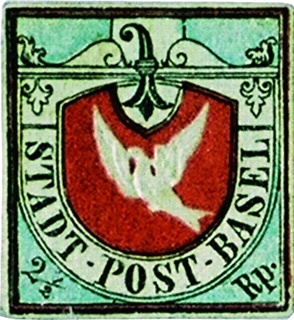
Basel Dove stamp scan, via Wikimedia Commons, Public Domain
On July 1, 1845, the Swiss canton of Basel issued its first and only postage stamp. It depicted a white dove carrying a letter in its beak, printed in three colors on an embossed background. The Basel Dove, known locally as the Basler Dybli or Basler Taube, was the world's first tricolor stamp and one of the earliest postage stamps produced anywhere outside of Great Britain. Today, it is one of the most treasured stamps in philately, with mint examples valued in the millions.
Quick Value Summary
Item: 1845 Basel Dove (Basler Taube)
Year: 1845
Issuing Authority: Canton of Basel, Switzerland
Denomination: 2½ Rappen
Category: Stamps
Condition Range:
- Used, poor condition: $5,000 - $15,000
- Used, good condition (clean cancel): $15,000 - $50,000
- Used, fine condition with margins: $50,000 - $150,000
- Unused with gum: $200,000 - $500,000
- Mint, exceptional quality: $500,000 - $2,300,000
Record Sales: Mint examples have been valued at $2.3 million. A block of four unused stamps was estimated at over $1,000,000.
Rarity: Approximately 100-150 examples are believed to survive in all conditions. Unused examples are extremely rare.
The Story
Switzerland in 1845 was not yet a unified postal system. Individual cantons operated their own mail services and issued their own stamps. Zurich had been the first Swiss canton to issue stamps in March 1843, followed by Geneva later that year. Basel became the fifth stamp-issuing entity in the world (after Great Britain, Zurich, Geneva, and Brazil) when it issued the Basel Dove on July 1, 1845.
The stamp was designed by Melchior Berri (1801-1854), a prominent Basel architect best known for designing the Basel Trade Fair building. Berri created an elegant design featuring a white embossed dove carrying a letter, set against a vivid background printed in three colors: red, blue, and black. The tricolor printing was technically innovative for its time and made the Basel Dove the world's first multicolored postage stamp.
The dove symbolized peaceful communication, an appropriate image for a postal stamp. The denomination of 2½ Rappen covered the cost of sending a single-weight letter within the city of Basel. The stamps were printed by the firm of Bischoff & Son in Basel using a combination of letterpress (for the colored background) and embossing (for the white dove).
Basel issued the Dove stamp for only a few years before Switzerland's federal postal system took over cantonal mail services in 1849. After that, the Basel Dove was replaced by federal Swiss stamps. The short production period, combined with normal postal use that destroyed most examples, accounts for the stamp's rarity today.
Philatelists have identified several sub-varieties based on printing characteristics, including the famous "Haube auf Taube" (cap on dove) variety, where a printing flaw creates what appears to be a small cap or hat on the dove's head. This variety commands a premium among specialists.
How to Identify It
Design: A white embossed dove carrying a letter, facing left, set within a shield-shaped frame.
Colors: The background uses three colors: red (or crimson), blue (or vivid blue), and black. The dove itself is unprinted (embossed white paper).
Denomination: "2½ RAPPEN" or "2½ Rp" printed on the stamp.
Size: Approximately 22mm x 27mm.
Paper: Thick, white wove paper. The embossing of the dove should be visible and tactile.
No perforations: Like all stamps of this era, the Basel Dove is imperforate. Stamps were cut from sheets with scissors, so margin sizes vary.
Inscription: "STADT POST BASEL" (City Post Basel) appears on the stamp.
Common confusions:
Reproductions: High-quality reproductions of the Basel Dove exist and have been made for decades. Genuine examples have specific printing characteristics, paper quality, and embossing depth that experts can verify.
Forgeries: The stamp has been extensively forged since the 19th century. Some forgeries are themselves collectible as early philatelic forgeries.
Other Swiss cantonal stamps: Zurich 4 and 6 Rappen stamps (1843) and Geneva Double Prints are different cantonal issues that are sometimes confused with the Basel Dove by non-specialists.
Value by Condition
Used, Poor Condition: Heavy cancellation, paper thinning, tears, or missing margins. Even damaged examples sell for $5,000 to $15,000 due to the stamp's historical significance and rarity.
Used, Good Condition: Clear but not heavy cancel, good margins on at least two sides, intact embossing, vivid colors. Expect $15,000 to $50,000.
Used, Fine Condition: Light cancel, full or near-full margins on all sides, strong embossing, bright colors, no defects. These are the stamps that serious collectors seek. Expect $50,000 to $150,000.
Unused with Gum: Original gum present (though often disturbed after 180 years). Unused Basel Doves are extremely rare. Expect $200,000 to $500,000.
Mint, Exceptional Quality: Unused with full or large margins, strong embossing, vivid colors, and original gum. These are museum-quality stamps. Estimates range from $500,000 to $2,300,000. The highest valuation comes from StampSnap's current market estimate of $2.3 million.
Key value factors:
Margins: Stamps with full margins on all four sides are worth significantly more than examples with tight or cut-into margins.
Embossing quality: The dove embossing should be sharp and clearly defined. Flat or crushed embossing reduces value.
Color intensity: Vivid, bright colors command premiums over faded examples.
Cancel type and legibility: Light, neat cancels are preferred. Heavy or smudged cancels reduce value.
Varieties: The "Haube auf Taube" variety and other identified printing varieties carry premiums.
Authentication and Fakes
The Basel Dove is one of the most forged stamps in philatelic history:
Expert certification mandatory: Every Basel Dove should carry a certificate from a recognized philatelic expertizing body. In Switzerland, the Swiss Philatelic Expertizing Association provides authentication. Other authorities include the Royal Philatelic Society London (RPSL) and the Philatelic Foundation (US).
Paper analysis: Genuine Basel Doves are printed on specific thick wove paper from the 1840s. Paper thickness, texture, and aging characteristics are key diagnostics.
Embossing examination: The embossing technique used by Bischoff & Son creates a specific depth and character. Forgeries may attempt embossing but rarely match the original quality.
Color comparison: The specific red, blue, and black inks used have known characteristics. Ultraviolet light examination can reveal differences between genuine and forged inks.
Provenance: For stamps of this value, a documented chain of ownership from recognized collections adds significant confidence.
Where to Sell
David Feldman SA (Geneva): One of the world's premier philatelic auction houses, particularly strong in Swiss stamps. They regularly handle major Basel Dove sales.
Corinphila Auctions (Zurich): Another Swiss auction house with deep expertise in cantonal stamps.
Robert A. Siegel Auction Galleries (New York): The leading US philatelic auction house with international reach.
Sotheby's and Christie's: Both major auction houses have occasional philatelic departments for exceptional stamps.
Private treaty: For stamps valued above $100,000, private sale through an established philatelic dealer may be preferred to avoid public auction dynamics.
Not sure about the condition of yours? Upload a photo to Curio Comp for a quick estimate.
Explore More
The Basel Dove stands at the intersection of art, technology, and history. It was innovative in its tricolor printing, beautiful in its design, and meaningful in its purpose. Today, it represents one of philately's ultimate collecting goals and a tangible piece of Swiss heritage.
Related Items
Have This Item?
Our AI appraisal tool is coming soon. Upload photos, get instant identification and valuation.
Get Appraisal