1958 Gibson Les Paul Standard (Sunburst, Flame Top)
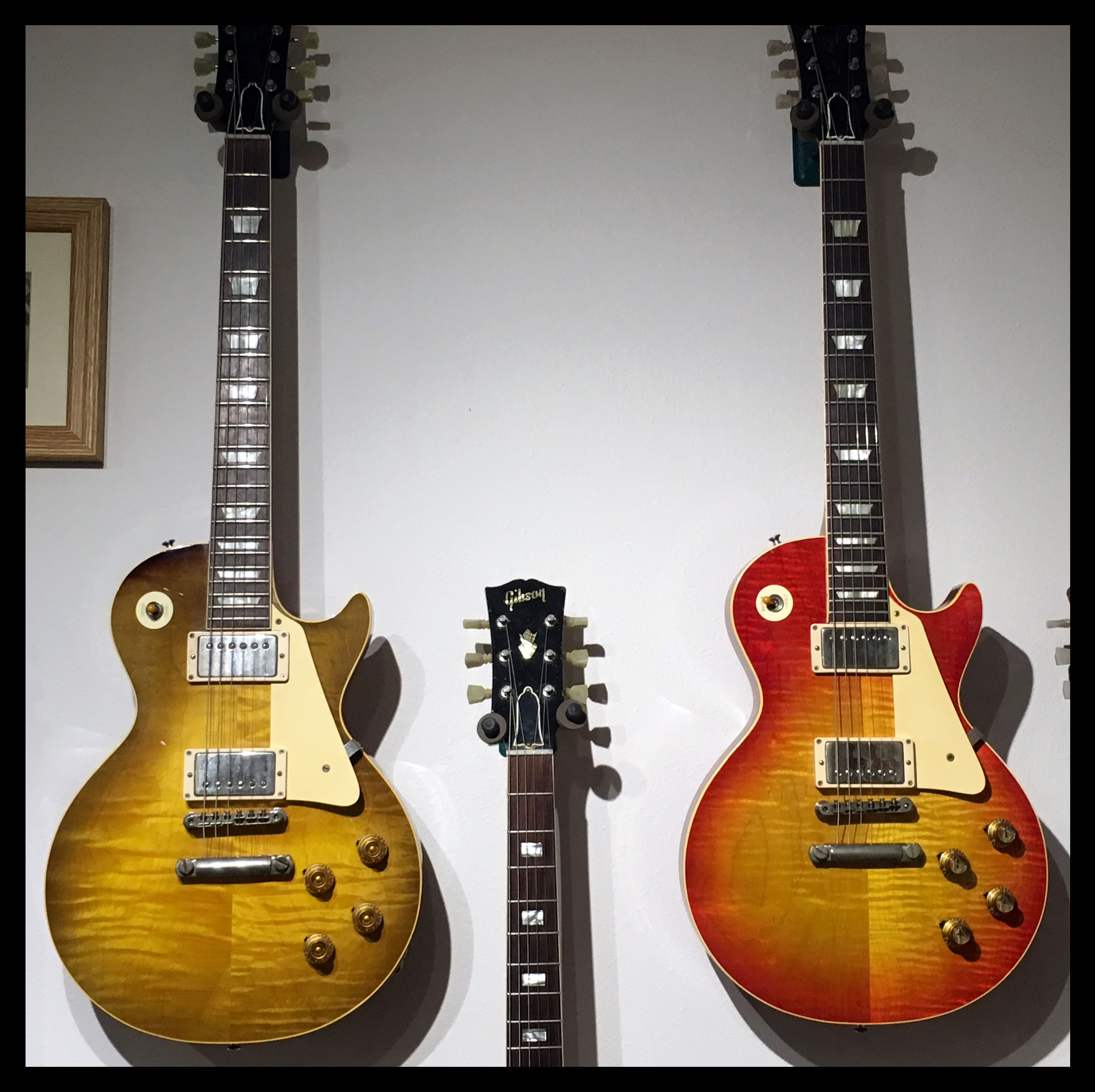
Lightburst, CC BY-SA 4.0, via Wikimedia Commons
The 1958 Gibson Les Paul Standard with a Cherry Sunburst finish and flame maple top is, without exaggeration, the most sought-after electric guitar in the world. These instruments, collectively known among collectors as "Bursts," represent the absolute summit of vintage guitar collecting, where six-figure and even seven-figure prices are not unusual. A 1958 Standard with exceptional flame on its maple top combines historical significance, legendary tone, and breathtaking visual beauty into a single instrument that has achieved near-mythical status among musicians and collectors alike.
The Birth of the Sunburst Standard
The Les Paul model had been in Gibson's lineup since 1952, initially featuring a gold finish (hence the nickname "Goldtop") and P-90 single-coil pickups. In 1957, Gibson introduced the PAF (Patent Applied For) humbucker pickup, designed by Seth Lover, which gave the Les Paul a warmer, fatter, and more powerful sound while eliminating the hum that plagued single-coil designs.
In mid-1958, Gibson made two changes that would prove historic. First, the gold finish was replaced with a Cherry Sunburst, a transparent finish that graduated from dark cherry red at the edges to a warm amber or honey color in the center, allowing the natural figure of the maple top to show through. Second, Gibson began using maple tops with more prominent figuring, or "flame," creating a visual effect that made each guitar unique.
The 1958 Les Paul Standard was, to put it plainly, a commercial failure. Gibson shipped approximately 434 Les Paul Standards in 1958, and roughly half of those still wore the Goldtop finish from earlier in the year. That means somewhere around 200 to 250 Sunburst Les Pauls were produced in 1958, making it the rarest of the three "Burst" years (1958, 1959, and 1960). The guitar's $280 retail price (roughly $2,900 in today's dollars) was considered expensive, and many guitarists of the era preferred Fender's Telecaster and Stratocaster for their brighter, more cutting tones.
Sales were so disappointing that Gibson discontinued the Les Paul Standard in 1961, replacing it with the SG (Solid Guitar) design. It was a decision they would come to regret.
The Rediscovery
The Les Paul Standard's transformation from commercial dud to the most valuable production guitar in history is one of the great comeback stories in music. In the mid-1960s, British blues-rock guitarists began discovering that the Les Paul's thick, sustaining tone was perfect for the heavier, more distorted sounds they were exploring.
Eric Clapton's use of a Les Paul Standard with John Mayall's Bluesbreakers (captured on the 1966 album Blues Breakers with Eric Clapton, famously known as the "Beano album") was a turning point. Clapton's thick, singing tone on that record inspired a generation of guitarists to seek out Les Pauls. Mike Bloomfield, Peter Green, Keith Richards, Jeff Beck, and Jimmy Page all played Les Paul Standards during this period, cementing the guitar's reputation as the instrument of choice for blues-based rock.
By the early 1970s, Gibson had reintroduced the Les Paul Standard, and the original 1958 to 1960 Sunbursts had begun their ascent in the collector market. What had once been a $280 guitar was selling for $2,000. By the 1990s, prices had reached $100,000. Today, the finest examples command $300,000 to $500,000 or more.
What Makes a 1958 Different
The three "Burst" years (1958, 1959, and 1960) each have distinct characteristics that experienced players and collectors can identify:
1958: The first year of the Sunburst finish. The neck profile is typically described as a "chunky" or "baseball bat" shape, rounder and thicker than the 1959 neck. Some players love this profile for its substantial feel, while others prefer the slightly slimmer 1959. The finish tends toward a darker, more cherry-heavy sunburst compared to later years. Early 1958 examples may have the transition-era combination of a Sunburst top with Goldtop-style appointments.
1959: Widely considered the most desirable year, with a "medium fat" neck profile that many players find ideal. The flame tops on 1959 models are often spectacular, and the finish tends to be more balanced between cherry and amber.
1960: The neck profile becomes noticeably thinner and flatter, which some players prefer for speed and others find less comfortable. The finish on late 1960 models sometimes shows a brighter, more orange tint.
All three years feature the same fundamental construction: a mahogany body with a carved maple top, a mahogany set neck, a rosewood fretboard, two PAF humbucker pickups, and a Tune-o-matic bridge with a stop tailpiece. The differences are subtle but significant to collectors, and the 1958 models hold a special allure as the year it all began.
The Flame Top Factor
The maple top on a Les Paul Standard is carved from a solid piece of maple, and the natural grain pattern varies dramatically from guitar to guitar. Tops with prominent, dramatic figuring (referred to as "flame," "tiger stripe," or "curly" maple) are vastly more desirable than plain or lightly figured tops.
The visual appeal of a flame top is undeniable: under changing light, the figuring appears to shimmer and move, creating a three-dimensional effect that photographs can only partially capture. The intensity and regularity of the flame are major value drivers. A 1958 Les Paul with a spectacular, heavily figured flame top can be worth two to three times as much as an identical guitar with a plain maple top.
Flame is graded informally by collectors on a rough scale:
Plain: Minimal or no visible figure. Still valuable as a Burst, but at the lower end.
Light Flame: Some figure visible, particularly when the guitar is moved in light.
Medium Flame: Clear, attractive figuring across most of the top.
Heavy Flame: Dramatic, deep figuring that covers the entire top. Highly desirable.
Exhibition Grade: Extraordinary flame with near-perfect symmetry and depth. Exceedingly rare and commands the highest premiums.
Value Guide
The value of a 1958 Gibson Les Paul Standard depends primarily on originality, condition, and the quality of the flame top:
| Condition / Configuration | Estimated Value |
|---|---|
| All Original, Exhibition Flame, Excellent Condition | $400,000 - $600,000+ |
| All Original, Heavy Flame, Excellent Condition | $300,000 - $450,000 |
| All Original, Medium Flame, Very Good Condition | $200,000 - $350,000 |
| All Original, Light/Plain Top, Good Condition | $150,000 - $250,000 |
| Refinished or with Replaced Parts | $75,000 - $150,000 |
| Heavily Modified or Restored | $40,000 - $100,000 |
Originality is paramount. The most valuable Bursts are those with all original components: pickups, tuners, bridge, tailpiece, wiring, capacitors, potentiometers, pickup rings, knobs, switch tip, and even the original case (a brown or black "lifton" case). Replaced parts reduce value proportionally to their significance, with pickup replacements being the most costly deduction.
Authentication
The market for vintage Les Paul Standards is, unfortunately, rife with counterfeits, forgeries, and misrepresented instruments. Authenticating a genuine 1958 Burst requires expert knowledge of:
Serial Numbers and Factory Order Numbers: 1958 Les Pauls have serial numbers in specific ranges and corresponding factory order numbers. Both should be consistent with known Gibson production records.
Pot Codes: The potentiometers (volume and tone controls) are date-coded with a format that reveals the manufacturer and the week and year of production. These codes must be consistent with a 1958 build date.
PAF Pickups: Original PAF pickups have specific characteristics including patent number stickers (or the absence thereof on very early examples), specific bobbin colors, wire types, and magnet compositions that experts can verify.
Wood and Construction: The mahogany body, maple top carving profile, neck joint, fretboard inlays, binding, and dozens of other construction details must be consistent with known 1958 production methods.
Finish: The original nitrocellulose lacquer finish on a 1958 Burst will show characteristic aging, including checking (fine cracks in the finish), fading, and patina. The depth and character of this aging is extremely difficult to replicate convincingly.
For any guitar represented as a 1958 Les Paul Standard, professional authentication by a recognized expert is absolutely essential before purchase. Experts such as those at Gruhn Guitars, Norman's Rare Guitars, and other established vintage dealers can provide detailed evaluations.
The Sound
Beyond collecting, the 1958 Les Paul Standard is revered for its tone. The combination of the mahogany body, carved maple top, PAF humbuckers, and the specific properties of the aged nitrocellulose lacquer produces a sound that countless guitarists describe as the ultimate electric guitar tone: warm, thick, sustaining, with a singing quality on the neck pickup and a biting growl on the bridge.
The aging of the wood and electronics over 60-plus years contributes to this tonal character in ways that are difficult to quantify scientifically but universally acknowledged by players. The capacitors dry out slightly, the magnets in the pickups age, and the wood itself changes at a molecular level. These processes create an instrument that sounds genuinely different from even the most faithful modern reproduction.
Investment Perspective
Original 1958 Les Paul Standards have appreciated more dramatically and more consistently than almost any other collectible instrument. From $280 new to $500,000 or more today, the percentage return is staggering, though it is important to note that most of this appreciation occurred after the guitars had already become expensive.
The investment case for these guitars rests on several pillars: absolute scarcity (perhaps 200 to 250 Sunbursts made in 1958, with some lost or destroyed over the decades), enduring musical relevance, and the iconic status of the Les Paul Standard in popular culture. As long as electric guitar music remains culturally important, these instruments will retain their value and their allure.
That said, at current price levels, buying a 1958 Les Paul Standard purely as an investment carries significant risk. The market for six-figure guitars is thin, liquidity can be limited, and a single economic downturn could temporarily compress values. As with all collectibles at the highest levels, purchasing should be motivated primarily by passion and appreciation rather than financial speculation.
Famous 1958 Les Paul Standards
Several specific 1958 Les Paul Standards have achieved fame in their own right. While the most celebrated Bursts tend to be 1959 models (such as Peter Green's "Greeny," which sold for an undisclosed sum reportedly near $2 million, or the "Black Beauty" Les Paul Customs), the 1958 models have their own stories.
Gibson's records from this era are incomplete, and many early Sunbursts have passed through multiple hands over the decades, sometimes with gaps in their documented ownership history. This provenance mystery adds to the romance of the Burst market. Every year, previously unknown examples surface from attics, closets, and collections, each with its own story of how it survived six-plus decades.
The fact that these guitars were considered undesirable when new actually contributed to their survival in some cases. Owners who could not sell them simply stored them, sometimes in cases that were not opened for decades. These "closet finds" occasionally emerge with remarkably well-preserved finishes and untouched components, and they generate enormous excitement in the collecting community when they do.
A Guitar Like No Other
The 1958 Gibson Les Paul Standard with a Sunburst finish and flame maple top is more than a guitar. It is a cultural artifact, a piece of music history, and, in its finest examples, a work of functional art. Fewer than 250 were made, each one unique in its figuring, its color, and its voice. Players and collectors have spent decades pursuing them, and the mystique shows no sign of fading.
If you are fortunate enough to encounter a genuine 1958 Les Paul Standard, whether in a shop, at auction, or (as still occasionally happens) at an estate sale or garage sale where its value is unknown, you are looking at one of the rarest and most valuable production instruments ever made. Verify its authenticity, appreciate its beauty, and recognize that you are holding a piece of history that connects you directly to the birth of rock and roll.
Related Items
Have This Item?
Our AI appraisal tool is coming soon. Upload photos, get instant identification and valuation.
Get Appraisal