Dungeons & Dragons White Box (1974, Original Print Run, TSR)
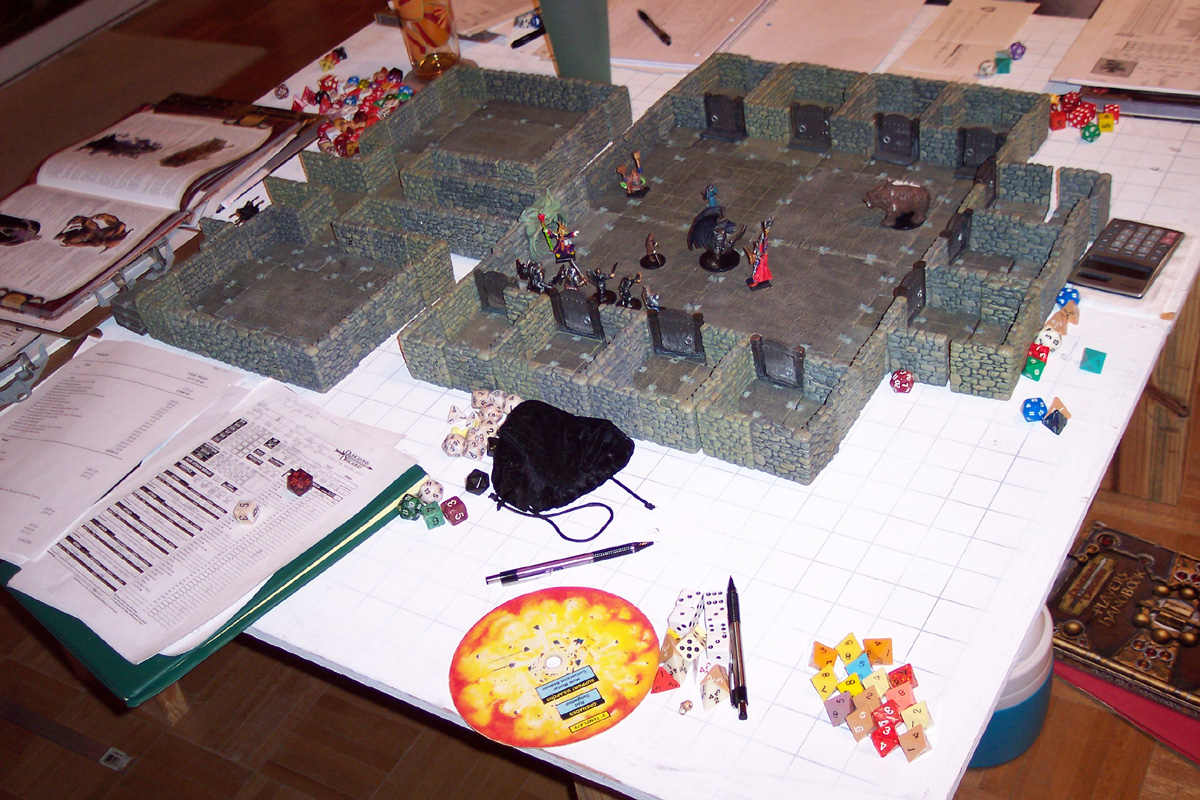
Photo by Waza, 2007. Dungeons & Dragons game in progress. Licensed under Creative Commons Attribution-Share Alike 3.0 Unported (CC BY-SA 3.0). Via Wikimedia Commons.
The Game That Started Everything
In January 1974, a small company called Tactical Studies Rules (TSR) published a boxed set that would create an entirely new form of entertainment. Dungeons & Dragons, written by Gary Gygax and Dave Arneson, was the world's first commercially published role-playing game. The initial print run of about 1,000 copies, packaged in a woodgrain-patterned box, sold out within months. Over fifty years later, those early boxes are among the most sought-after items in all of gaming collectibles, with first printing woodgrain sets selling for over $20,000 at auction.
The set that would later become known as the "White Box" (after later printings switched to a plain white box) laid the foundation for an industry that now generates billions of dollars annually. Every role-playing game, computer RPG, and adventure video game that followed owes a direct debt to what Gygax and Arneson created.
The Birth of a New Hobby
Dungeons & Dragons grew out of the miniature wargaming community of the early 1970s. Gygax, based in Lake Geneva, Wisconsin, was already an established figure in wargaming circles. He had co-created Chainmail (1971), a medieval miniatures wargame that included a fantasy supplement with rules for wizards, dragons, and heroes. Dave Arneson, a wargamer from the Twin Cities in Minnesota, had been running an experimental campaign called Blackmoor that focused on individual characters exploring underground dungeons rather than armies clashing on battlefields.
When Arneson visited Gygax in Lake Geneva and demonstrated his Blackmoor campaign, Gygax immediately recognized the potential. The two began collaborating on a set of rules that would formalize Arneson's concepts into a publishable game. The result was Dungeons & Dragons, subtitled "Rules for Fantastic Medieval Wargames Campaigns Playable with Paper and Pencil and Miniature Figures."
Gygax shopped the game to established wargame publishers, including Avalon Hill, but was turned down. He decided to publish it himself through TSR, a company he had co-founded with Don Kaye in 1973. The production budget was just $2,000 for a thousand copies.
What Was in the Box
The original set contained three digest-sized booklets:
Volume 1: Men & Magic (36 pages) covered character creation, including three character classes (Fighting-Man, Magic-User, and Cleric), four races (Human, Dwarf, Elf, and Hobbit), three alignments (Lawful, Neutral, and Chaotic), and the basic mechanics of the game.
Volume 2: Monsters & Treasure (40 pages) cataloged the creatures and magical items that players would encounter. Many monsters were drawn from mythology and literature, including dragons, griffons, trolls, and others.
Volume 3: The Underworld & Wilderness Adventures (36 pages) provided rules for dungeon exploration, wilderness travel, and castle construction. It also included guidelines for naval combat and aerial encounters.
The set also included six reference sheets with tables and charts essential for gameplay.
The rules assumed players already owned Chainmail and used its combat system, though an optional alternative combat system was included that would eventually become the standard. The rules also assumed ownership of Outdoor Survival, an Avalon Hill board game, for use as a wilderness map.
The Artwork and Production
With only $100 budgeted for artwork, Gygax recruited anyone who could hold a pencil. The artists included Cookie Corey, a local Lake Geneva artist; Greg Bell, a member of Jeff Perren's gaming group; Dave Arneson himself; Gygax's wife's half-sister Keenan Powell; and TSR co-founder Don Kaye. Each artist received $2 for a small piece or $3 for a larger one, plus identical royalties for each additional thousand copies printed.
Several of Greg Bell's illustrations were based on existing comic book art, particularly from Marvel's Strange Tales. The cover art showing a sword-wielding Viking warrior on a rearing horse was adapted from Strange Tales #167. The illustration of a sorcerer before a blazing cauldron in the Monsters & Treasure booklet was similarly sourced from a Doctor Strange panel.
The production quality was, by any standard, amateurish. The booklets were digest-sized, the printing was rough, and the binding was basic. None of that mattered. The ideas inside were revolutionary.
Printing History and Box Variations
Understanding the printing history is essential for collectors. The original set went through multiple printings between 1974 and 1979, with significant variations:
First Printing (January 1974): The "Woodgrain Box." Approximately 1,000 copies printed. The box has a wood-colored pattern with an adhesive cover sheet showing a mounted warrior. The price was $10.00. The Men & Magic booklet features a mounted warrior cover illustration. This printing refers to "Hobbits" and "Ents" (later changed due to Tolkien estate legal pressure).
Second Printing (Late 1974): Also in a woodgrain box but with minor text corrections. Still highly collectible.
Third Printing (1975): Continued the woodgrain box pattern with additional corrections.
Fourth Printing (Late 1975): The first "White Box" printing. TSR switched to a plain white box. This is the first printing of what collectors commonly call the White Box edition.
Fifth Printing (1976): White box with further corrections. Some copies begin appearing with the "Original Collector's Edition" (OCE) starburst label.
Sixth Printing (1977-1979): The OCE starburst is standard. The Men & Magic booklet cover changed to a fighter with a sword. "Hobbits" became "Halflings" and "Ents" became "Treants."
Value Guide
| Printing/Variation | Condition | Approximate Value |
|---|---|---|
| 1st Print Woodgrain (Complete) | Near Mint | $15,000-$25,000+ |
| 1st Print Woodgrain (Complete) | Very Good | $8,000-$15,000 |
| 1st Print Woodgrain (Complete) | Good/Fair | $3,000-$8,000 |
| 2nd-3rd Print Woodgrain | Very Good+ | $3,000-$8,000 |
| 4th Print White Box (First White) | Very Good+ | $1,500-$4,000 |
| 5th-6th Print White Box (OCE) | Very Good+ | $800-$2,500 |
| 6th Print White Box (OCE) | Good | $400-$800 |
| Incomplete Sets (Any Print) | Varies | $100-$2,000 |
Record Sale: A first printing woodgrain set in excellent condition sold for approximately $22,100 through Heritage Auctions. Complete first printings with all booklets, reference sheets, and original box in good condition routinely sell in the $10,000-$20,000 range.
Condition Assessment Guide
Box: The most vulnerable component. Woodgrain boxes are especially fragile. Check for corner splits, tape reinforcement (very common), lid warping, and adhesive cover sheet lifting or damage. White boxes show dirt and handling marks readily.
Booklets: Check for completeness first. All three volumes plus reference sheets should be present. Look for cover detachment, spine cracking, page tanning, pencil marks (players often wrote in their booklets), water damage, and missing pages.
Reference Sheets: The six loose reference sheets are frequently lost or damaged. Complete sets with all sheets intact command significant premiums.
Dice: Original dice are rarely present. TSR initially did not include dice with the set, instead providing instructions to make chits from the reference sheets. Later printings included low-quality dice that were often discarded. Original dice add modest value but are not a major price driver.
Condition Grades for Investment Potential
A+ (Near Mint/Complete): All three booklets plus reference sheets in excellent condition, box intact without tape repairs. Exceptionally rare for a 50+ year old game box. $15,000+.
A (Very Good+/Complete): All components present with moderate wear. Booklets solid, box shows handling but is intact. $5,000-$15,000 depending on printing.
B+ (Very Good/Complete): Noticeable wear, possible small tape repairs on box, booklets show use but are complete. $2,000-$5,000.
B (Good/Mostly Complete): Heavy wear, possible missing reference sheets, box may have significant tape repairs. $500-$2,000.
C (Fair/Incomplete): Major components missing, heavy damage, but identifiable as an original set. $100-$500.
Authentication and Identification Tips
The most critical identification point is the printing. Here is how to determine which printing you have:
- Box color: Woodgrain pattern = 1st-3rd printing. White = 4th printing onward.
- OCE starburst: The "Original Collector's Edition" starburst label appears starting with the 5th printing.
- Men & Magic cover: Mounted warrior = 1st-5th printing. Fighter with sword = 6th printing.
- Hobbit vs. Halfling: "Hobbit" in the text = 1st-5th printing. "Halfling" = 6th printing.
- Price: $10.00 price = early printings. Later printings show higher prices.
The Acaeum (acaeum.com) maintains the definitive reference guide for identifying D&D printings and is an essential resource for serious collectors.
The 2013 Premium Reprint
In 2013, Wizards of the Coast released a premium reprint edition in a wooden box. Each booklet featured new cover art but was otherwise a faithful reproduction of the original interior text and artwork. The set also included the first four supplement booklets (Greyhawk, Blackmoor, Eldritch Wizardry, and Gods, Demi-Gods & Heroes). These reprints sell for $150-$300 and are a viable alternative for collectors who want the content without the five-figure price tag.
Market Trends
The market for original D&D sets has strengthened significantly since the game's 50th anniversary in 2024. Several factors drive demand:
Nostalgia: Many collectors who played D&D in the 1970s and 1980s are now in their peak earning years.
Cultural resurgence: Stranger Things, Critical Role, and the Dungeons & Dragons: Honor Among Thieves film have brought unprecedented mainstream attention to the hobby.
Scarcity: Only about 1,000 first printings were produced, and many were played to destruction.
Crossover appeal: The original White Box appeals to gaming collectors, book collectors, pop culture enthusiasts, and history-of-technology buffs.
First printing woodgrain sets have appreciated approximately 15-20% annually over the past five years. White Box OCE editions have seen more modest but steady gains of 8-12% annually.
Collecting Tips
- Completeness is king. A complete set with all booklets and reference sheets is worth dramatically more than an incomplete one. Loose booklets without a box sell for a fraction of complete sets.
- Do not clean or repair. Amateur cleaning or tape repair can reduce value. Leave conservation work to professionals.
- Document everything. Photograph all components, including the inside of the box, the title pages, and the reference sheets. This documentation is essential for insurance and resale.
- Buy from specialists. Noble Knight Games, the Acaeum community, and Heritage Auctions are trusted sources. Random eBay listings carry higher risk of misidentified printings.
- Store properly. Keep in a cool, dry environment. Acid-free tissue paper between booklets prevents foxing transfer. Avoid attics, basements, and garages.
Why It Belongs in Your Collection
The original Dungeons & Dragons boxed set is arguably the most important game product ever published. It created the role-playing game genre, inspired generations of video games from Ultima to Baldur's Gate, and established concepts like character classes, experience points, and hit points that permeate modern gaming culture. Owning an original set is owning a piece of entertainment history as significant as a first edition of any landmark novel or an original pressing of any landmark album.
Related Items
Have This Item?
Our AI appraisal tool is coming soon. Upload photos, get instant identification and valuation.
Get Appraisal