Axis & Allies 1981 Nova Game Designs First Edition
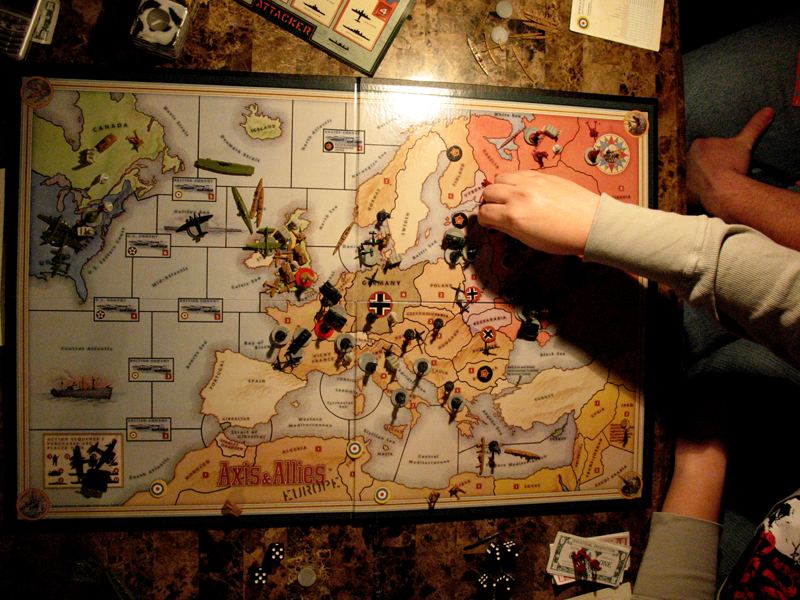
Photo by Liverpoolpics via Flickr, Wikimedia Commons, CC BY 2.0. Axis & Allies Europe game board.
Quick Value Summary
Condition Estimated Value Complete, good box, played condition $200 - $400 Complete, very good condition, all chits intact $400 - $800 Complete, near-mint with original shrinkwrap remnants $800 - $1,500 Factory sealed (extremely rare) $2,000 - $4,000+ Incomplete (missing chits, rules, or map) $50 - $150 Values based on eBay completed sales, BoardGameGeek marketplace data, and specialty vintage game dealer prices (2022-2025). The sealed copy is nearly unheard of.
How a Connecticut Hobby Shop Changed Wargaming
In the late 1970s, a young game designer named Larry Harris was working on a prototype he called "1942." It was an ambitious concept: a grand strategic World War II board game that let players control entire nations, combining military tactics with economic management. The game used a Spring 1942 political map of Earth divided into territories, with five players taking on the roles of Germany, Japan, the Soviet Union, the United Kingdom, and the United States.
Harris brought his creation to the Citadel Game Store, a hobby shop in Connecticut owned by Pat Flory. Flory saw the game's potential and agreed to publish it. They formed a small company called Nova Game Designs, and Flory suggested the name "Axis & Allies" (replacing Harris's working title). In 1981, Nova Game Designs produced a print run of approximately 5,000 copies, according to community historians on the Axis & Allies forums. The game was catalogued as part of the "Citadel Series" with the designation AAA-007-LH.
Those 5,000 copies were a far cry from the millions that would eventually be produced. The Nova edition was a decidedly low-budget affair compared to what came later. Instead of the molded plastic miniatures that Milton Bradley would introduce, the Nova version used sheets of colored cardboard chits that players punched out. The map was a paper sheet rather than a mounted game board. The rulebook was simpler, the components were basic, and the box art was modest.
But the game itself was brilliant. It hit a sweet spot between hardcore hex-and-counter wargames and accessible family board games. You could teach it in 30 minutes and play it in an afternoon. The combination of dice-based combat, territory control, and economic production created endless strategic possibilities. Word spread through hobby shops and gaming groups.
The Milton Bradley Takeover
What happened next is one of the most consequential moments in board game history. An employee at Nova Game Designs left to work at Milton Bradley. Before long, MB was interested in Axis & Allies. In 1984, Milton Bradley republished the game as part of their Gamemaster Series, alongside titles like Conquest of the Empire, Broadsides and Boarding Parties, Fortress America, and Shogun.
The MB edition was a massive upgrade in production quality. It featured a full mounted game board, paper money, and (crucially) hundreds of small plastic miniature pieces representing infantry, tanks, fighters, bombers, battleships, aircraft carriers, submarines, and industrial complexes. This edition, retroactively called "Axis & Allies: Classic," became the version most people know. It went on to sell nearly two million copies and was inducted into the Academy of Adventure Gaming Arts & Design Hall of Fame in 1996.
The franchise has since spawned more than fifteen distinct board game versions, including theater-specific editions like Axis & Allies: Europe, Axis & Allies: Pacific, and the massive Axis & Allies: 1940 Global combination. In 2023, Renegade Game Studios took over publishing from Hasbro's Avalon Hill division.
Identifying the 1981 Nova Edition
The Nova first edition is distinctive and fairly easy to tell apart from all subsequent versions:
Box: The Nova edition box is noticeably smaller and lighter than the Milton Bradley version. It features simpler artwork. Look for "Nova Game Designs" and "Citadel Series" on the packaging. The designation "AAA-007-LH" may appear on the box or components.
Components: The game uses flat cardboard chits (counters) instead of plastic miniatures. The chits come on perforated sheets in different colors representing the five powers. There are also sheets with unit statistics and initial setup information.
Map: A paper map sheet rather than a mounted board. The map shows a Spring 1942 political world map divided into territories, similar to (but not identical to) later editions.
Rules: A simpler rulebook compared to later editions. The rules are shorter and cover fewer edge cases than the expanded Milton Bradley rules.
Dice: Standard dice included. Some surviving copies have had their dice replaced over the decades, so non-original dice are not necessarily a red flag for an otherwise complete copy.
No plastic pieces of any kind. If the game has plastic miniatures, it is not the Nova edition.
Completeness Checklist
A complete Nova first edition should include:
Box with lid
Paper map sheet
Sheets of unpunched (or punched) cardboard unit chits in five colors
Unit statistics sheets
Initial setup reference sheets
Rulebook
Dice
The most common issue with surviving copies is missing or damaged chits. Because these are thin cardboard, they are easily lost, bent, or damaged after 40+ years. A complete set of chits in good condition is the single most important factor in determining value.
What Makes It Valuable
Several factors drive the value of the Nova first edition:
Scarcity. Only about 5,000 were produced, compared to nearly two million of the Milton Bradley version. Of those 5,000, many were played extensively and discarded over the decades. The number of complete, well-preserved copies in collector hands is likely in the low hundreds.
Historical significance. This is where one of the most successful wargame franchises in history began. For collectors of board game history, owning a Nova edition is like owning a first edition of Dungeons & Dragons or a pre-Milton Bradley version of Monopoly.
Nostalgia and community. The Axis & Allies community is large and passionate. BoardGameGeek has extensive discussions about the Nova edition, and a 2021 video showing the unboxing of what was described as "the only SEALED Axis and Allies from 1981 published by Nova Games we have ever seen" generated significant interest.
The Larry Harris connection. Harris remains active in the gaming community and has continued designing Axis & Allies variants and editions for over 40 years. His involvement gives the original game additional collector appeal.
Common Issues and Variations
Box condition is a persistent issue. The Nova boxes were not built to the same standards as later MB boxes. Worn corners, faded covers, and split seams are common.
Chit condition matters enormously. Unpunched chit sheets are rare and very desirable. Most surviving copies have punched chits that may be bent, worn, or incomplete. Count the chits carefully against a known checklist if you are evaluating a potential purchase.
Rules variants. There may be minor printing variations in the rulebook across the production run, but no major variants have been documented. This is not like a book where a "first state" dust jacket commands a premium over a "second state."
Replacement components. Some sellers list copies as "complete" when they have replaced missing chits with hand-drawn or printed substitutes. Examine all components carefully.
Authentication and Avoiding Fakes
Outright fakes of the Nova edition are not a major problem, unlike some other collectible games. The economics simply do not support counterfeiting a $200-$800 item with multiple components. However, there are concerns to be aware of:
"Complete" sets that are not actually complete. This is the most common issue. Sellers may not realize they are missing chits, or they may hope buyers will not check.
Misidentified editions. Some sellers incorrectly list the 1984 Milton Bradley first edition as the "original" or "first edition" Axis & Allies. The MB edition is worth considerably less ($30-$80 for a complete played copy).
Mixed components. A Nova box containing some Milton Bradley components (or vice versa) is worth less than a pure set.
The "sealed" question. Claims of factory-sealed Nova copies should be treated with extreme skepticism. With only 5,000 produced over 40 years ago, genuine sealed copies are extraordinarily rare. The 2021 BoardGameGeek unboxing video of a sealed copy was treated as a notable event precisely because sealed copies are so uncommon.
What a Complete Nova Edition Plays Like
If you actually want to play your Nova edition (and some collectors do), there are a few things to know. The gameplay is recognizably Axis & Allies, but the rules are simpler than later editions. There is no technology development track, no strategic bombing, and fewer unit types. The map has fewer territories, and the economic system is more streamlined.
Many players describe the Nova edition as faster-playing than later versions. A full game can be completed in 2-3 hours rather than the 4-6 hours (or more) that some later editions demand. The cardboard chits, while less visually dramatic than plastic miniatures, are actually quite functional and arguably easier to manage on the smaller map.
The rules have some quirks that were later refined. Submarine warfare works differently, and there are fewer special rules for specific unit interactions. If you are used to a later edition, the Nova rules may feel both simpler and occasionally surprising.
For preservation purposes, if you have a valuable complete copy, consider playing with a later edition and keeping the Nova set in display condition.
Where to Buy and Sell
eBay is the most active marketplace for vintage board games, including the Nova edition. Search for "Axis Allies Nova 1981" or "Axis Allies first edition 1981." Check completed/sold listings for realistic pricing.
BoardGameGeek Marketplace is the best venue for reaching serious collectors. Listings here tend to be more accurately described than eBay, and the community will quickly call out misrepresentations.
Specialty vintage game dealers like Dallas Vintage Toys stock the Nova edition when available. Dealer prices run 20-40% above eBay prices, but you get professional condition grading and a return policy.
Selling costs:
eBay fees: approximately 13.25% (final value fee) plus shipping costs
BoardGameGeek Marketplace: $0.25 listing fee, no commission
Dealer consignment: 30-40% commission, but less hassle
Private sale: no fees, but you need to find the buyer
Shipping considerations. The Nova edition is lighter and smaller than the MB version, which keeps shipping costs reasonable ($8-$15 domestic USPS Priority). Pack it well. The box is fragile, and collectors care about box condition.
Displaying and Preserving Your Copy
If you are fortunate enough to own a Nova edition, a few preservation tips:
Store flat, not on edge. The box is not as rigid as later editions, and standing upright can cause warping and corner damage.
Keep chits in bags. Small zip-lock bags, separated by nation color, prevent chit-to-chit friction and keep everything organized.
Avoid direct sunlight. The box art and paper components will fade with UV exposure.
Control humidity. Cardboard components are susceptible to moisture damage. Store in a climate-controlled space.
Photograph everything. Document the condition of your copy thoroughly. This helps with insurance and with potential future sales.
Some collectors display their Nova edition in a shadow box or behind glass, with the map and chit sheets laid out alongside the box. This makes for an impressive display piece, especially alongside a Milton Bradley edition for comparison.
Related Items
Have This Item?
Our AI appraisal tool is coming soon. Upload photos, get instant identification and valuation.
Get Appraisal