1964 Peace Dollar (Rumored/Myth)
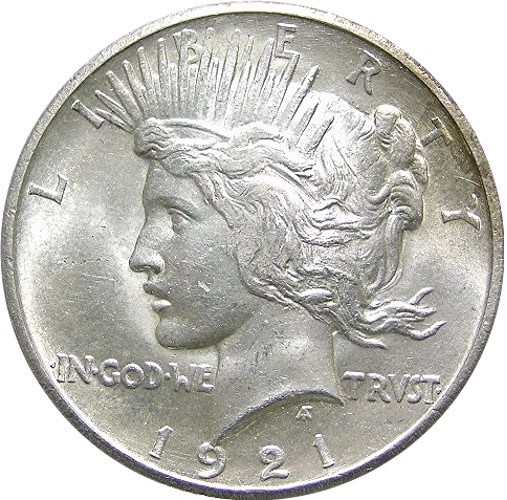
Wikimedia Commons, Public Domain (U.S. coin)
Quick Value Summary
This is not a typical value guide. The 1964 Peace Dollar has no legal market value because the U.S. government considers all examples to be federal property subject to confiscation. No authenticated specimen has ever been publicly offered for sale.
Item Estimated Value Authenticated genuine 1964-D Peace Dollar Theoretically $1,000,000+ (but illegal to own) Dan Carr / Moonlight Mint fantasy overstrike $50 - $200 Chinese counterfeit "1964-D Peace Dollar" $0 (worthless, deceptive) Original Peace Dollar (1921-1935, common dates) $25 - $50 in VF condition If someone is offering you a "1964 Peace Dollar" for sale, it is either a fantasy piece, a counterfeit, or stolen government property.
A Dollar That Shouldn't Exist
Here's one of the strangest stories in American numismatics. In 1964, the United States Mint struck 316,076 silver Peace dollars at the Denver Mint. Then the government destroyed every single one. Or did they?
The 1964-D Peace dollar occupies a unique place in coin collecting. It has an official mintage figure. The government confirms it was produced. Yet the official position is that zero examples exist outside of federal control. No museum has one. Not even the Smithsonian. PCGS has a standing $10,000 reward just to look at a genuine example, and nobody has collected it.
That contradiction, a coin that was definitely made but supposedly no longer exists, is what keeps this story alive decades later.
The Coin Shortage Crisis
To understand why the 1964 Peace dollar was created, you need to understand what was happening with American money in the early 1960s.
Silver coins were disappearing from circulation at an alarming rate. The price of silver had been climbing, and by 1963, the melt value of silver coins was approaching their face value. People were hoarding them. Businesses in Western states, particularly Nevada's casinos, relied heavily on silver dollars for daily operations and were running critically short.
The last silver dollars produced had been Peace dollars in 1935. For nearly thirty years, no new ones had been struck. The Treasury had been releasing stockpiled silver dollars to meet demand, but the reserves were running out.
Congress and the Johnson administration faced pressure from Western politicians, especially Nevada Senator Howard Cannon, to authorize new silver dollar production. The argument was straightforward: people needed dollar coins, so mint some.
Authorization and Production
On August 3, 1964, President Lyndon B. Johnson signed legislation authorizing the production of 45 million silver dollars. The coins would use the existing Peace dollar design by Anthony de Francisci, the same design that had been in production from 1921 through 1935.
But here's where things got complicated. Despite the August 1964 authorization, actual coin striking didn't begin until mid-May 1965. Between May 13 and May 24, 1965, the Denver Mint struck 316,076 Peace dollars bearing the 1964 date and the D mintmark.
Mint officials later described these as "trial strikes," though producing over 300,000 coins goes well beyond what most people would consider a trial run. The coins used the traditional 90% silver composition and the standard Peace dollar design.
The Backlash and Cancellation
Almost immediately, the program ran into a wall of public opposition. Critics made several arguments:
The hoarding problem. If silver coins were already being hoarded, minting new silver dollars would just give hoarders more coins to squirrel away. The new dollars would vanish from circulation just like the old ones.
The silver supply issue. The United States was already struggling with silver supplies. Using scarce silver to mint coins that would be hoarded rather than circulated seemed wasteful.
The speculation angle. Coin collectors and dealers openly discussed how a new Peace dollar dated 1964 would be worth far more than face value. The coins would go straight into collections and safe deposit boxes, not into cash registers.
The Mint's capacity. During an ongoing coin shortage, dedicating Mint resources to silver dollars that wouldn't actually circulate felt counterproductive to many members of Congress who hadn't supported the original authorization.
The criticism was fierce enough that the Treasury pulled the plug. Just days after production began, orders came down to stop and destroy what had been made.
The Destruction (and the Questions)
The Mint reported that all 316,076 coins were melted under heavy security. According to CoinWeek's research, workers verified the melt by weight rather than by individual coin count. That detail has been the source of speculation ever since.
The story doesn't quite end with the bulk melt, though. According to PCGS's published history, Mint records indicate that 30 coins were set aside as trial strikes. Of those 30, 28 were melted immediately. Two were sent to Washington, D.C. for optical and physical testing and sat in a Treasury vault until spring 1970, when records say they were finally destroyed.
So the official narrative involves two separate destruction events (the bulk melt in 1965 and the final two coins in 1970) with a five-year gap between them. Plenty of time for questions to develop.
The Legal Reality
This part is not debatable and not negotiable for collectors.
In May 1973, the Treasury Department issued a ruling that the 1964-D Peace dollar is illegal to own privately. Because the coins never entered lawful circulation, any surviving example is considered government property subject to seizure. There is no statute of limitations on the government's right to reclaim the coins themselves.
The situation is analogous to the 1933 Double Eagle, where the Secret Service has actively confiscated specimens from private holders. In that case, only one example received legal private ownership status (the Farouk specimen, which sold for $7.59 million in 2002 and again for $18.87 million in 2021). Every other 1933 Double Eagle that has surfaced has been seized.
If a genuine 1964-D Peace dollar were to appear, the owner would face a difficult choice: reveal it and likely have it confiscated, or keep it hidden and never be able to sell it publicly.
The PCGS Bounty
In January 2013, Professional Coin Grading Service (PCGS) announced a $10,000 reward simply to examine and authenticate a genuine 1964-D Peace dollar. They weren't offering to buy it. They weren't promising to help the owner keep it. They just wanted to see one.
As of 2025, nobody has collected that bounty. That's over a decade of one of the most prominent organizations in numismatics publicly asking to see this coin, with money on the table, and getting no takers.
That fact alone tells you something. Either every single coin was truly destroyed, or anyone holding one understands the legal risks of coming forward.
What Survived: The Master Die
While no struck coin sits in any known collection, one physical artifact does survive. Coin World has reported that a master die for the 1964 Peace dollar exists at the Philadelphia Mint. This die, used to create the working dies that were shipped to Denver for production, confirms that the project progressed well beyond the planning stage. Real tooling was created, real coins were struck, and the infrastructure for full-scale production was in place.
The Fakes and Fantasy Pieces
Because the real coin is unobtainable, the market has filled the void with substitutes. You should know what's out there.
Chinese counterfeits: The most common "1964-D Peace dollars" you'll find online, especially on sites like AliExpress or unvetted eBay listings, are outright fakes manufactured in China. These are typically made from base metal with silver plating and weigh noticeably less than a genuine Peace dollar (which should weigh 26.73 grams of .900 silver). They have no collectible value and are illegal to sell as genuine coins in the United States.
Dan Carr / Moonlight Mint fantasy pieces: Dan Carr, a respected private minter, has produced "concept" pieces by overstriking genuine older coins with a 1964-D Peace dollar design. These are clearly marked as private issues and are sold as numismatic curiosities, not as genuine Mint products. They typically sell for $50 to $200 depending on the base coin used and collector interest. Carr is transparent about what these are, and they have a small but dedicated following among collectors who appreciate the craftsmanship.
Altered date coins: Some fakers take genuine 1934 or 1935 Peace dollars and attempt to alter the date to read 1964. These range from crude (obvious tooling marks) to sophisticated. Weight and diameter will be correct because the base coin is genuine silver, making detection harder. Look for unnatural surfaces around the date numerals under magnification.
How to Protect Yourself
Any "1964 Peace Dollar" offered for sale is not genuine. Full stop. If the price seems like a deal, it's because it's fake.
If you're interested in fantasy pieces, buy directly from Dan Carr's Moonlight Mint website or from dealers who clearly identify them as private issues.
If someone claims to have a genuine example, they are either mistaken, lying, or in possession of illegal government property. Do not buy.
PCGS and NGC will not grade a 1964-D Peace dollar because its legal status makes it ineligible for the commercial marketplace.
What Would a Real One Be Worth?
This is purely hypothetical, but the question gets asked constantly. If a 1964-D Peace dollar somehow achieved legal status (as the Farouk 1933 Double Eagle did), auction estimates suggest it could bring $1 million or more. The combination of the backstory, the rarity (potentially unique), and the crossover appeal beyond the coin collecting community would drive extraordinary bidding.
But that's fantasy. The practical value of this coin today is zero for private collectors because it cannot be legally owned or sold.
Why This Story Matters to Collectors
The 1964-D Peace dollar represents something collectors rarely encounter: a coin with verified production records that remains completely unobtainable. Most "rare" coins are simply coins with low mintages that occasionally surface at auction. The 1964-D Peace dollar is different. It was deliberately destroyed by the same government that made it.
This makes it a perfect case study in the intersection of numismatics, government policy, and collector psychology. It raises questions that don't have clean answers. What constitutes legal ownership of a coin? When the government produces something and then says nobody can have it, is that the end of the story? And what happens if, decades from now, a genuine example surfaces in an estate or a forgotten vault?
The 1964-D Peace dollar also serves as a cautionary tale for collectors. Desire and rarity don't create value if legality prevents a market from existing. You can want something desperately, you can know it was real, and it can still be worthless to you because the law says you can't have it.
For now, the 1964-D Peace dollar remains a ghost. A coin that existed, that might still exist somewhere, but that can never legally enter the world of collectors and commerce. It is the most famous coin you will never own.
Related Items
Have This Item?
Our AI appraisal tool is coming soon. Upload photos, get instant identification and valuation.
Get Appraisal