1910-S Lincoln Wheat Cent
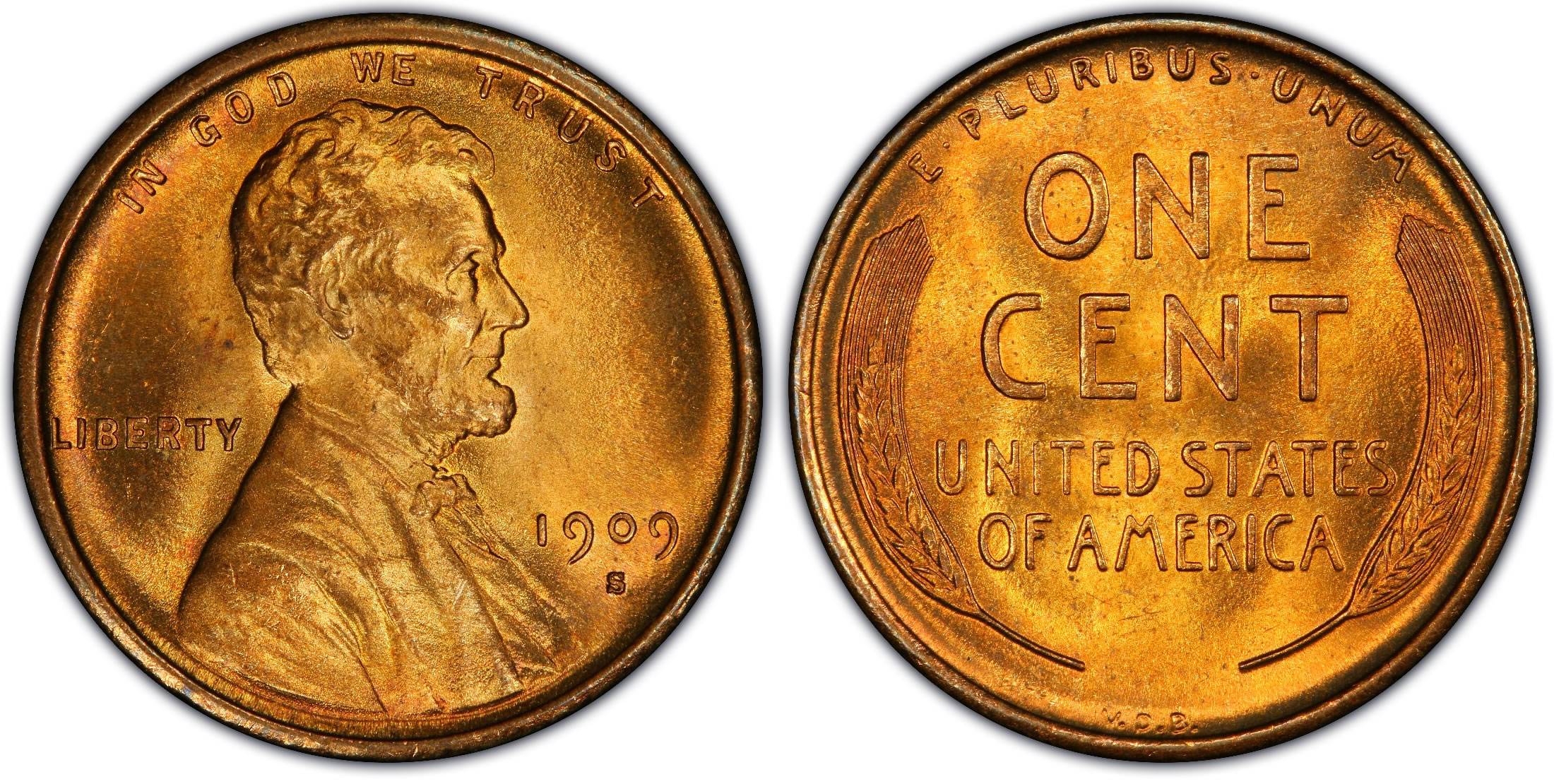
Public domain, via Wikimedia Commons. US Government work.
A Second-Year Treasure from San Francisco
The 1910-S Lincoln Wheat Cent holds a special place in American numismatics. As only the second year of production for what would become the longest-running coin design in United States history, this San Francisco issue carries both historical weight and genuine scarcity. With a mintage of just 6,045,000 pieces, the 1910-S stands as a classic semi-key date that bridges the gap between affordable entry points and serious collecting.
While the Philadelphia Mint churned out over 146 million Lincoln cents that same year, the San Francisco facility produced a fraction of that total. That disparity in production numbers is exactly what makes the 1910-S so appealing to collectors today. It represents an era when the Lincoln cent was still fresh, still novel, and still being produced in quantities that would later seem modest by comparison.
The Birth of a Series
The Lincoln cent debuted in 1909, designed by Victor David Brenner at the request of President Theodore Roosevelt. Roosevelt had admired Brenner's work on a plaque depicting Abraham Lincoln and believed the Lithuanian-born sculptor could bring artistic distinction to American coinage. The result was a portrait that captured Lincoln's dignity and resolve, paired with a reverse featuring two stalks of durum wheat framing the words "ONE CENT" and "UNITED STATES OF AMERICA."
The coin was revolutionary for its time. It marked the first instance of a real historical figure appearing on a regular-issue United States coin. Previous designs had used allegorical figures like Liberty in various forms. Placing Lincoln's portrait on the humble penny was both a tribute to the 16th president on the centennial of his birth and a departure from long-standing numismatic tradition.
The series launched amid controversy over Brenner's prominent initials "V.D.B." on the reverse. Public outcry led the Mint to remove them after just a few weeks of production, creating the famous 1909-S VDB variety that remains one of the most sought-after coins in American numismatics. By 1910, the dust had settled. Brenner's initials were gone from the coin entirely (they would return in tiny form on the obverse shoulder truncation in 1918), and production continued at all active mint facilities.
What Makes the 1910-S Special
The San Francisco Mint's output of 6,045,000 Lincoln cents in 1910 places this issue squarely in semi-key date territory. For context, here is how the 1910 mintages compare:
1910 Lincoln Cent Mintage Comparison
Philadelphia (no mint mark): 146,801,218
San Francisco (S): 6,045,000
That ratio of roughly 24 to 1 tells the story. For every 1910-S cent that exists, there are about two dozen Philadelphia issues. This scarcity becomes even more pronounced in higher grades, where the 1910-S is genuinely difficult to locate.
All early S-mint Lincoln cents from 1909 through 1915 are considered semi-key dates, and the 1910-S sits comfortably within that group. Among this cohort, the 1910-S and 1913-S are generally regarded as the most accessible in circulated grades, while issues like the 1909-S VDB, 1911-S, and 1914-S command significantly higher premiums.
Design Details
The obverse of the 1910-S Lincoln cent features Brenner's right-facing portrait of Abraham Lincoln. The word "LIBERTY" appears to Lincoln's left, "IN GOD WE TRUST" arcs across the top, and the date "1910" sits at the bottom. The small "S" mint mark is located below the date, indicating production at the San Francisco Mint.
The reverse displays two wheat stalks curving along the left and right borders, giving the design its popular nickname: the "Wheat Penny" or "Wheat Back." Between the wheat stalks, "ONE CENT" appears in large letters above "UNITED STATES OF AMERICA." The motto "E PLURIBUS UNUM" runs across the top of the reverse.
The coin specifications remained consistent throughout the Wheat Cent era:
Technical Specifications
Composition: 95% Copper, 5% Tin and Zinc
Weight: 3.11 grams
Diameter: 19 mm
Edge: Plain
Designer: Victor David Brenner
Condition and Grading
Like all early Lincoln cents, the 1910-S is evaluated based on wear patterns, surface quality, and color designation. The Sheldon grading scale runs from 1 (barely identifiable) to 70 (perfect), with major grade thresholds that dramatically affect value.
For the 1910-S specifically, collectors should focus on several key areas when assessing condition. On the obverse, Lincoln's cheekbone and jawline show wear first. The highest points of his hair above the ear are also vulnerable to contact and circulation wear. On the reverse, the wheat stalks' individual lines and the lettering sharpness indicate grade.
Condition Grades at a Glance
Good (G-4): Outline of Lincoln's portrait visible, major features flat. Wheat stalks show minimal detail. Value: approximately $19
Very Good (VG-8): Some hair detail visible, wheat stalks show partial lines. Value: approximately $22
Fine (F-12): About half of hair detail visible, wheat stalks clearer. Value: approximately $26
Very Fine (VF-20): Most hair detail present with moderate wear on high points. Value: approximately $38
Extremely Fine (EF-40): Nearly full detail with light wear on highest points only. Value: approximately $69
About Uncirculated (AU-50): Slight trace of wear on Lincoln's cheekbone. Value: approximately $103
Uncirculated (MS-60): No wear, though contact marks and luster breaks may be present. Value: approximately $132
Choice Uncirculated (MS-63): Attractive luster with only minor distractions. Value: approximately $178
Color Designations
Copper coins receive additional color designations that significantly impact value:
Brown (BN): The coin has oxidized to a brown tone. Most circulated and many uncirculated examples fall here. This is the most common color for surviving 1910-S cents.
Red-Brown (RB): The coin retains between 5% and 95% of its original mint red color. These transitional pieces offer a balance of visual appeal and relative affordability.
Red (RD): The coin retains at least 95% of its original bright copper-red color. Red examples in mint state are the most desirable and command substantial premiums. A 1910-S in MS-65 Red can bring several thousand dollars at auction.
Market Values and Price Trends
The 1910-S Lincoln cent has shown steady appreciation over the decades, particularly in higher grades. While it remains affordable in well-circulated condition, prices escalate quickly as grade improves.
Current Market Value Ranges
G-4 to VG-8: $19 to $22
F-12 to VF-20: $26 to $38
EF-40 to AU-50: $69 to $103
MS-60 to MS-63 (Brown): $132 to $178
MS-64 to MS-65 (Red-Brown): $300 to $800
MS-65 Red and above: $1,500 to $5,000+
Auction records for top-graded specimens have reached impressive figures. PCGS and NGC certified examples in MS-66 Red or higher are rare enough that they generate significant bidding competition when they appear at major auction houses.
Compared to other semi-key dates in the series, the 1910-S offers solid value. The 1911-S typically costs 50% to 100% more at comparable grades, while the 1909-S (non-VDB) commands similar premiums to the 1910-S. This makes the 1910-S an excellent starting point for collectors building an early date Lincoln cent collection.
Collecting Strategies
For Budget Collectors
The 1910-S in Good to Fine condition represents one of the most affordable semi-key dates in the Lincoln cent series. At $19 to $26, collectors can own a coin that is over 115 years old with genuine numismatic significance. Look for problem-free examples with clear dates and mint marks. Even at these lower grades, avoid coins with heavy corrosion, cleaning, or environmental damage.
For Intermediate Collectors
Very Fine to Extremely Fine examples offer the best balance of detail and value. In the $38 to $69 range, you get a coin with visible hair detail, clear wheat stalk lines, and enough character to display well. This is the sweet spot for type collectors who want a representative early S-mint cent without paying mint-state premiums.
For Advanced Collectors
Mint state examples, particularly those with Red or Red-Brown color designations, are where the 1910-S becomes truly challenging. Third-party grading from PCGS or NGC is essential at this level, as the difference between MS-63 and MS-65 can represent thousands of dollars. Eye appeal matters enormously. Two coins in the same numeric grade can have vastly different visual qualities, and experienced collectors learn to be selective.
Authentication and Counterfeiting Concerns
While the 1910-S is not among the most commonly counterfeited Lincoln cents, collectors should still exercise caution. The most frequent issue is not outright counterfeiting but rather added mint marks. Unscrupulous individuals have been known to add an "S" to common Philadelphia-minted 1910 cents to create fake 1910-S examples.
Key authentication points include:
The mint mark should show natural striking characteristics, not appear pasted on or overly sharp compared to surrounding details
The font style and positioning of the "S" should be consistent with genuine examples
Weight should be close to 3.11 grams
Diameter should measure 19 mm
For any coin being purchased at semi-key date premiums, third-party certification from PCGS or NGC provides an important layer of protection. The modest cost of certification is well justified for coins valued above $50.
Historical Context: San Francisco in 1910
The San Francisco Mint that produced the 1910-S Lincoln cent was the "Granite Lady," the third San Francisco Mint facility, which had famously survived the devastating 1906 earthquake and fire. Located at Fifth and Mission Streets, this fortress-like building became a symbol of resilience after mint employees fought to save both the structure and its contents during the disaster.
By 1910, San Francisco was deep in its rebuilding phase. The city was transforming itself from the ashes of 1906, and the mint was operating at reduced capacity compared to the Philadelphia facility. The relatively modest mintage of 6,045,000 Lincoln cents reflected both the regional demand for coinage and the mint's production priorities, which also included gold and silver coins for West Coast commerce.
How the 1910-S Fits the Broader Series
Collectors building a complete set of Lincoln Wheat Cents (1909 to 1958) will encounter the 1910-S as one of the first significant hurdles. The series progression looks roughly like this in terms of difficulty and cost:
Early Semi-Key Dates (1909-1915 S-Mint)
1909-S VDB: The king. Expensive at every grade level.
1909-S: Scarce, premium over Philadelphia issue.
1910-S: Semi-key, accessible in circulated grades.
1911-S: Tougher than 1910-S, higher premiums.
1912-S: Similar to 1911-S in difficulty.
1913-S: Comparable to 1910-S in availability.
1914-S: Scarcer, significant premium.
1914-D: The other major key date.
1915-S: Rounds out the early semi-key group.
The 1910-S serves as an excellent gateway coin for this group. If you can afford a nice 1910-S, you can begin planning for the tougher dates knowing what the market looks like at this level.
Storage and Preservation
Copper coins are reactive metals that respond to environmental conditions. Proper storage is essential for maintaining value, particularly for higher-grade specimens.
Store in inert plastic holders (Mylar flips or hard plastic capsules)
Avoid PVC-containing soft plastic flips, which can cause green surface damage over time
Maintain stable temperature and humidity
Never clean a coin. Cleaning destroys original surfaces and dramatically reduces value
Handle by edges only, preferably with cotton gloves
For certified coins in PCGS or NGC holders, the slabs themselves provide excellent protection. For raw coins, 2x2 Mylar flips or airtight capsules are recommended.
The Investment Perspective
The 1910-S Lincoln cent has been a steady performer in the numismatic market. It benefits from several favorable factors:
Series popularity: Lincoln cents are the most widely collected U.S. coin series, ensuring consistent demand
Finite supply: No more will ever be made, and attrition reduces surviving populations over time
Affordable entry: Low-grade examples remain accessible to new collectors
Grade-sensitive appreciation: Higher-grade examples have shown strong long-term price growth
As with any collectible, purchasing the highest quality you can afford tends to yield the best long-term results. A single MS-64 Red-Brown example will likely appreciate more reliably than a dozen Good-4 specimens.
Final Thoughts
The 1910-S Lincoln Wheat Cent represents everything that makes early American coinage compelling. It carries genuine scarcity without being prohibitively expensive. It connects collectors to the earliest days of a series that has endured for well over a century. And it rewards careful study, because understanding the nuances of grade, color, and eye appeal can mean the difference between a good purchase and a great one.
Whether you are filling a hole in a Whitman folder or pursuing a registry-quality collection, the 1910-S deserves your attention. At its best, it is a beautifully struck piece of early 20th-century artistry that captures the craft of the San Francisco Mint during one of the most dynamic periods in that city's history.
Related Items
Have This Item?
Our AI appraisal tool is coming soon. Upload photos, get instant identification and valuation.
Get Appraisal