1879 Flowing Hair Stella $4 Gold Pattern
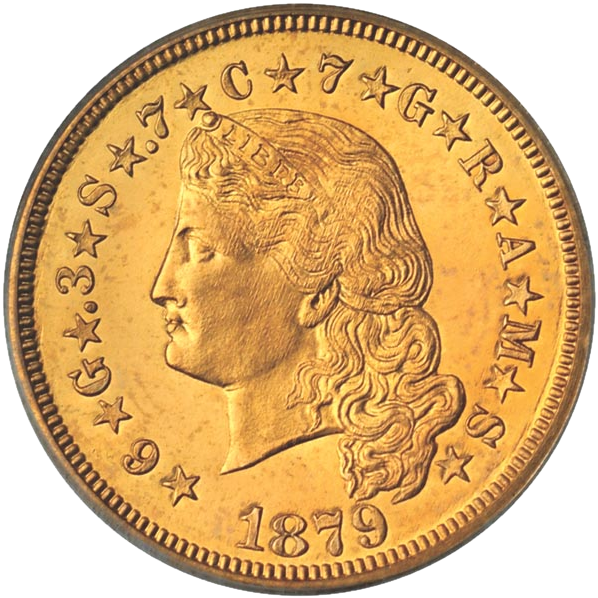
US federal government, Public domain, via Wikimedia Commons
The 1879 Flowing Hair Stella: America's Most Beautiful Pattern Coin
If you had to pick one coin that captures everything fascinating about the United States Mint's experimental history, the 1879 Flowing Hair Stella $4 Gold Pattern would be a very strong candidate. It is a coin that was never meant for everyday commerce, minted in tiny quantities for political purposes, and yet it has grown into one of the most celebrated rarities in American numismatics. Understanding what the Stella is, why it exists, and why collectors pay extraordinary sums for it requires a brief journey into the global monetary politics of the late 19th century.
The International Monetary Conference and the Birth of the Stella
In the 1870s, the United States government was actively exploring participation in an international monetary union. European nations, particularly France, had already established the Latin Monetary Union in 1865, creating a standardized gold coinage that could circulate freely across member countries. The vision was compelling: a universal gold coin that any traveler or merchant could use without currency exchange headaches. Merchants trading across borders dealt with constant conversion calculations, varying purities, and the friction of moving money between monetary systems that did not speak the same language.
Congressman John A. Kasson of Iowa championed American participation in this movement. He proposed a new denomination specifically designed to match the weight and purity of major European gold coins, particularly the French 20-franc piece. The proposed coin would be worth approximately $4 in American currency and would carry the name "Stella," meaning "star" in Latin. This seemed appropriate, as the star was already a national emblem appearing on American coinage alongside the eagle.
The Stella was intended as a trade facilitation coin, a practical instrument of commerce rather than a collectible curiosity. It would weigh exactly 7 grams with a specific gold content meant to align with international standards. The edge inscription tells you exactly what you are holding: "6G.3S.7C 7 GRAMS" indicating 6 grams of gold, 0.3 grams of silver, and 0.7 grams of copper making up the total 7-gram weight. The inclusion of the actual metal composition in the edge lettering was itself a forward-thinking design choice, meant to provide instant verification for merchants and bankers unfamiliar with American coinage.
The broader context matters here. The 1870s were a period of intense debate about the monetary standard in the United States. The country had returned to a gold standard in principle and was working toward the resumption of specie payments after the Civil War-era suspension. Connecting American gold coinage to European standards would have signaled monetary seriousness and facilitated international commerce at a time when American exports were growing rapidly.
Two Designers, Two Competing Visions
Congress never actually authorized the Stella for circulation. Instead, the Mint produced pattern coins in 1879 and again in 1880, submitting them to Congress for consideration. Two different designers produced competing versions, and the contrast between them remains one of the most interesting artistic dialogues in American coin design history.
Charles E. Barber, who would later become famous for his Barber coinage series that appeared on dimes, quarters, and half dollars from 1892 through 1916, designed the Flowing Hair type. His design shows Liberty with long, flowing hair cascading down her neck and shoulders in a classical, somewhat romantic style. The design drew heavily from a pattern half eagle his father William Barber had created the previous year, giving the Flowing Hair Stella a family connection to an earlier experimental tradition. The obverse features a large star above Liberty's head, reinforcing the "Stella" concept directly in the portrait. Around the border, in the style of the period, appears "E PLURIBUS UNUM" and the date.
George T. Morgan, best known today for his Morgan Silver Dollar first struck in 1878, created the competing Coiled Hair design, showing Liberty with her hair neatly coiled and pinned in a more formal arrangement. Morgan's portrait has a tighter, more precise quality compared to Barber's flowing romanticism. Both versions share the same reverse, featuring a large five-pointed star in the center, the denomination "FOUR DOL." and "DEO EST GLORIA" (Glory be to God).
The artistic rivalry between these two designers was real and long-running. Barber and Morgan worked at the same Mint for years and held competing visions of what American coinage should look like. The Stella patterns are a rare case where both men's work on the same denomination can be directly compared.
Of the two designs, Barber's Flowing Hair version was produced in the largest quantities, with the Guide Book of United States Coins estimating approximately 425 examples struck. This makes the Flowing Hair Stella the most frequently encountered of all Stella varieties, though "frequently encountered" is entirely relative in the rarefied world of major American rarities. Most serious collectors will never see one in person outside of a major auction preview or museum display.
Where Did All the Stellas Go?
The historical record contains a fascinating and somewhat scandalous story about the distribution of Stella coins. Many of these patterns were reportedly given to members of Congress to encourage their support for the international monetary union proposal. Congressional enthusiasm for the coins, however, appears to have been directed more toward personal acquisition than toward actual policy consideration.
Contemporary accounts suggest that some congressmen's wives and companions received Stellas as jewelry gifts, occasionally having them set into pins or pendants. This explains why a meaningful portion of the Stellas known today show damage consistent with mounting or jewelry conversion, including holes drilled through the coin, solder residue on the edge or rim, or file marks where a setting was attached. Finding a Stella in undamaged, original condition adds substantially to its value and desirability.
This history of jewelry conversion is not just an interesting footnote. It speaks to the strange dual existence of the Stella: official enough to be produced by the United States Mint from properly alloyed gold, but never authorized enough to enter circulation, leaving examples available to be casually converted into personal adornments by those who received them as gifts. A coin that lived in a drawer or jewelry box for decades has a very different survival profile than one that circulated through commerce.
Congress ultimately never approved the Stella for circulation. The international monetary union concept that Kasson championed faded from the political agenda. American participation never materialized, and the $4 denomination was quietly abandoned after the 1880 striking. What remained were a few hundred pattern coins distributed among politicians, collectors, and Mint employees, plus the small numbers produced in 1880 as afterstrikes for collector sale.
The Four Varieties and Their Relative Rarity
Collectors recognize four distinct Stella varieties across the two years of production:
| Year | Design | Estimated Quantity | Relative Rarity |
|---|---|---|---|
| 1879 | Flowing Hair | ~425 | Most available |
| 1879 | Coiled Hair | ~10 | Extremely rare |
| 1880 | Flowing Hair | ~15 | Very rare |
| 1880 | Coiled Hair | ~10 | Extremely rare |
The 1879 Flowing Hair is therefore the entry point into Stella collecting, if entry point is even an appropriate term for coins that trade in the six-figure range. The 1879 Coiled Hair and both 1880 varieties are among the most significant rarities in all of American numismatics. A complete set of all four Stella varieties would represent a numismatic achievement that almost no collector has ever accomplished.
The 1880 varieties carry an additional layer of historical interest because they were produced after the international monetary union proposal had effectively died. Their existence is primarily attributable to collector demand and the entrepreneurial instincts of Mint officials who recognized that wealthy collectors would pay premium prices for examples of these attractive patterns.
Condition and Value: What to Expect
All Stellas were struck as proof coins, meaning they received multiple die strikes on specially prepared planchets to bring up all the fine details. In their original state, they would have displayed deeply mirrored fields and sharply frosted devices with the brilliant contrast that characterizes finest-quality proof coinage. Today, the condition of any given Stella depends heavily on its history of handling, storage, and whether it was ever converted to jewelry.
For the 1879 Flowing Hair specifically, auction results have demonstrated a wide range depending on grade:
| Grade (PCGS/NGC) | Approximate Value Range |
|---|---|
| PR-55 to PR-60 (circulated) | $80,000 to $120,000 |
| PR-62 to PR-63 | $150,000 to $250,000 |
| PR-64 | $300,000 to $450,000 |
| PR-65 and above | $500,000+ |
Damaged or impaired examples, meaning coins showing jewelry conversion marks, holes, or significant contact damage, trade at meaningful discounts but still command prices well into five figures given the coin's absolute rarity. Even a holed or damaged Stella is still a genuine rarity with significant historical importance.
The market for Stellas has been remarkably stable over the decades. Unlike some numismatic areas that experience boom-bust cycles tied to precious metal prices or collector fashion trends, the Stella occupies a permanent position on every serious collector's want list. Major coin market corrections rarely impact the very top of the rarity pyramid as severely as they affect common-date material.
How to Identify an 1879 Flowing Hair Stella
If you believe you have encountered a Stella, here are the key authentication points to verify:
Obverse features:
Liberty facing left with long, flowing, unrestrained hair
Large five-pointed star above Liberty's head
"E PLURIBUS UNUM" in the field
Date "1879" below the portrait
The portrait style is softer and more classical than typical American coinage of the period
Reverse features:
Large five-pointed star dominating the central field
"FOUR DOL." for the denomination
"DEO EST GLORIA" inscription
"UNITED STATES OF AMERICA" around the border
Edge:
Lettered edge reading "6G.3S.7C 7 GRAMS" indicating the metal composition
This edge lettering is one of the defining characteristics and extremely difficult to replicate convincingly in a fake
Physical specifications:
Diameter: 22 millimeters
Weight: 7 grams
Composition: approximately 86% gold, 4.3% silver, 10% copper
All examples are proof strikes; no business-strike Stellas exist
Red flags for fakes: Counterfeit Stellas do exist, and the substantial value of even impaired examples makes them attractive targets for forgers. Because the coins are pattern pieces struck with proof dies, authentic examples should show sharp, crisp detail in the highest relief points including the hair strands and star points. Be wary of any example showing uneven striking or mushy details. The edge lettering should be clean and consistent. The mirrored proof fields, even on heavily worn examples, should show evidence of original reflective surfaces. Any genuine Stella submitted to PCGS or NGC will be certified; purchasing a raw or uncertified Stella requires extreme caution and expert in-hand authentication by a recognized specialist.
The weight and diameter specifications are precise and easily tested. A coin that does not match 7.0 grams and 22 millimeters warrants immediate skepticism.
The Stella's Enduring Appeal
Few coins blend historical significance, visual appeal, and genuine rarity as effectively as the 1879 Flowing Hair Stella. It represents a specific moment when the United States was actively considering a more globally integrated monetary system, a proposal that ultimately went nowhere but left behind one of the most beautiful experimental coins ever produced by the Philadelphia Mint.
Collectors who pursue type sets of American gold coinage often find the Stella to be their most challenging acquisition, combining extraordinary price with genuine scarcity. Major auction houses including Heritage, Stack's Bowers, and others handle perhaps a dozen to twenty Stellas in a given year across all varieties and grades. The 1879 Flowing Hair is the variety a type collector is most likely to encounter, and it represents the accessible face of the Stella series.
For those serious about adding a Stella to their collection, patience and preparation matter. Buy only certified examples from PCGS or NGC holders. Attend major auction previews when possible to examine coins in person and develop an eye for the specific quality characteristics that differentiate desirable examples from impaired ones. Work with dealers who specialize in early American gold and pattern coinage. And budget accordingly, because even the most modestly graded 1879 Flowing Hair Stella represents a significant commitment.
The Stella rewards study. Every element of its design, its history, and its survival tells a story about American ambition, Congressional politics, the long relationships between competing designers, and the enduring human desire to hold something genuinely rare and beautiful. In a collecting world full of fascinating coins, the Stella stands apart.
Related Items
Have This Item?
Our AI appraisal tool is coming soon. Upload photos, get instant identification and valuation.
Get Appraisal